Fourteen seconds. That is the interval, trough to trough, at which an Atlantic surface disturbance stops behaving like wind chop and starts behaving like what surfers mean when they say swell — and it is also the number that the coasts at Biarritz, Hossegor, Ericeira and Fuerteventura translate, each in their own bathymetric grammar, into a breaking wave. In deep water, a wave train's group velocity is gT divided by 4π. At T = 14 seconds, that arithmetic returns roughly 10.9 metres per second, or about 21 knots. Multiply by the width of the North Atlantic, and a low no one on the coast watched becomes a wave three days later.
Methodology: What We Measured, What "Swell" Actually Denotes, and What This Piece Ignores on Purpose
We treat "swell" here as the technical term physical oceanography gives it: surface gravity waves that have escaped their generating wind field and now propagate as a decaying, dispersive train. The observable that separates swell from local sea is period T, measured in seconds between successive crests. Everything downstream — group velocity, refraction angle, breaking depth — is a function of T and the seafloor the wave meets.
Our four reference coasts come from the studio's own cartographic set: Biarritz (Grande Plage, 43.4853°N, 1.5584°W), Hossegor (La Gravière, 43.6713°N, 1.4420°W), Ericeira (Ribeira d'Ilhas, 38.9885°N, 9.4197°W) and Fuerteventura (El Cotillo, 28.6745°N, 14.0125°W). Coastline traces are from OpenStreetMap's `natural=coastline` layer via Overpass, ODbL-licensed. Wave physics comes from standard deep-water and shoaling relations found in any coastal engineering text.
We ignore three things on purpose: forecast numbers for any specific date, wave-height records for named events, and any technique instruction. This is a coast reading, not a forecast desk.
Finding #1: Period, Not Height, Is the Number That Separates Swell From Wind Chop
The public vocabulary of surfing is height. The physics vocabulary is period. Two wave trains can arrive at the same beach at the same significant wave height and behave as different animals entirely — one crumbling, one hollow — because their periods differ by four seconds.
Deep-water wave celerity C, the speed of an individual crest, is gT divided by 2π. At T = 6 seconds — the register of a stiff onshore wind at Fuerteventura — C is roughly 9.4 metres per second and the wavelength L (equal to gT² over 2π) is about 56 metres. At T = 14 seconds — a mid-latitude Atlantic swell reaching Ericeira — C climbs to 21.8 m/s and L to 306 metres. The 14-second wave is not slightly longer than the 6-second wave. It is more than five times longer, and it carries proportionally more energy through the water column below it.
That length is why period, not height, determines what a coast does with a wave. Wave energy penetrates to a depth of roughly L/2. A 6-second wave "feels" bottom only in the last 28 metres of water. A 14-second wave begins interacting with the seafloor 150 metres down, which means it starts refracting, focusing and organising itself long before the shoreline is in view. When surfers describe a swell as "having some grunt in it," what they are describing, without the equation, is the depth at which the wave started listening to the coast.
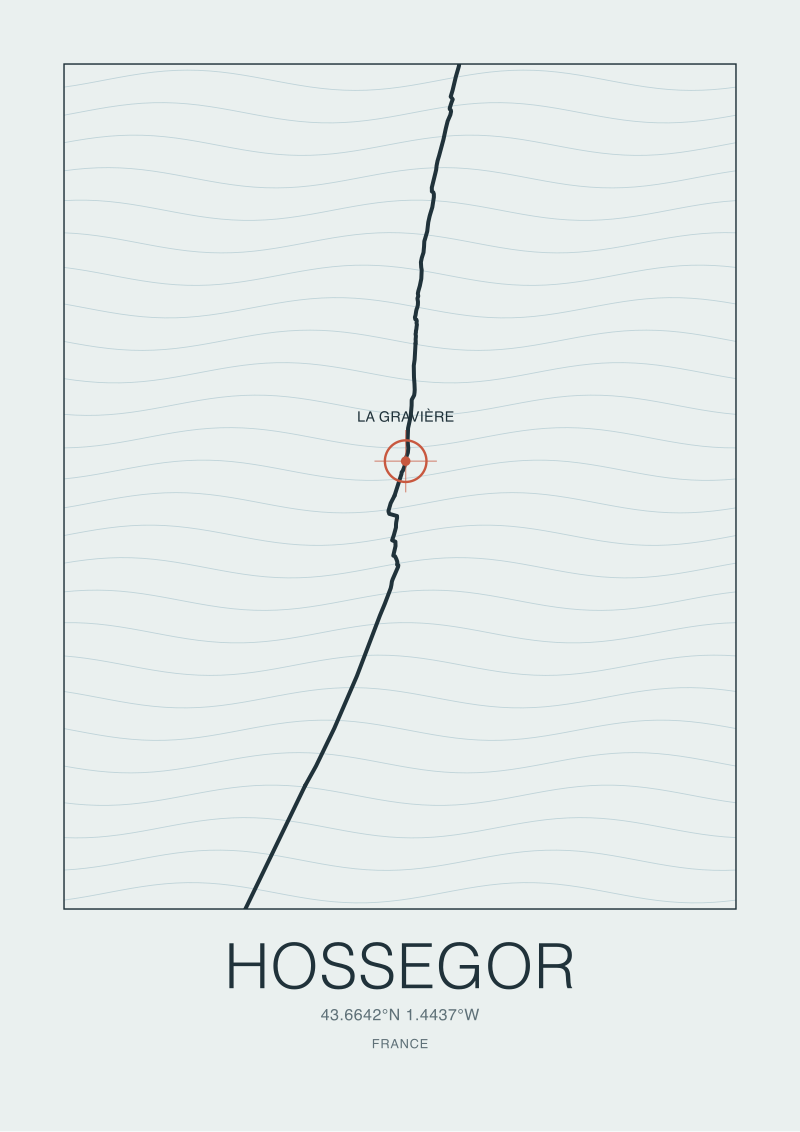 Hossegor
The print from this article · from €29.95
View the print →
Hossegor
The print from this article · from €29.95
View the print →
Finding #2: Group Velocity Explains Why a Storm You Never Saw Becomes a Wave at Hossegor Three Days Later
An individual crest travels at C. But wave energy travels at group velocity Cg, which in deep water is exactly half of C. Cg is gT divided by 4π. A 14-second train advances at 10.9 m/s. A 16-second train, common off Iberia in winter, advances at 12.5 m/s.
Hossegor sits at 43.67°N on the French southwest coast. A depression tracking east across the North Atlantic at latitude 50°N, spinning up seas 2,500 kilometres to the west-northwest of the Landes, will send its longest-period components toward the Bay of Biscay at roughly 12.5 m/s. Divide 2,500,000 metres by 12.5 metres per second and the answer is 200,000 seconds, or about 55 hours. Just over two days between the storm's peak and the first long-period corduroy reaching La Gravière.
This is the calculation that made pre-satellite surf forecasting possible. Bernard Le Méhauté in the 1960s, and the U.S. Navy's fleet routers before him, worked the same arithmetic in the opposite direction: given the swell now arriving at a coast, where and when was the storm? The dispersion of a swell train — long periods arriving first, shorter ones trailing — is a receipt. A clean, decreasing period sequence at Hossegor across 72 hours is not weather; it is the signature of a distant, discrete generating event whose energy has been sorted by the ocean itself into arrival order.
Finding #3: Ericeira and Fuerteventura Receive the Same Atlantic and Return Structurally Different Waves — the Coastline Does the Editing
Ericeira (38.99°N) and Fuerteventura's western coast at El Cotillo (28.67°N) sit on the same ocean. A North Atlantic winter swell propagating south-southeast can reach both, roughly a day apart. What each coast returns to the surfer is not the same wave.
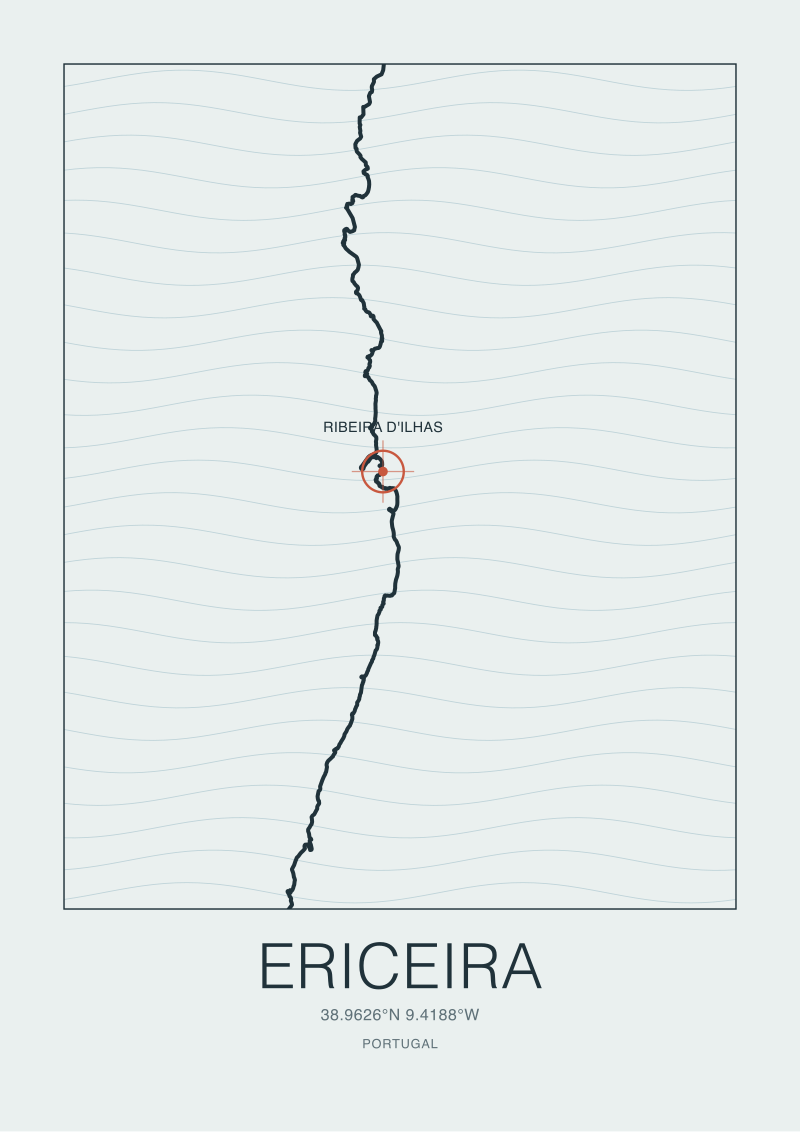
Ericeira's shelf narrows quickly. The 200-metre isobath sits within roughly 15 kilometres of Ribeira d'Ilhas. A long-period swell shoals across that shelf in a compressed distance, which concentrates energy and produces the reef waves the town is known for. The World Surfing Reserve designation in 2011 — the first in Europe — was granted precisely because of this geographic density: seven quality reef and point setups inside a short coastal segment, each activated by the same swell at slightly different angles.
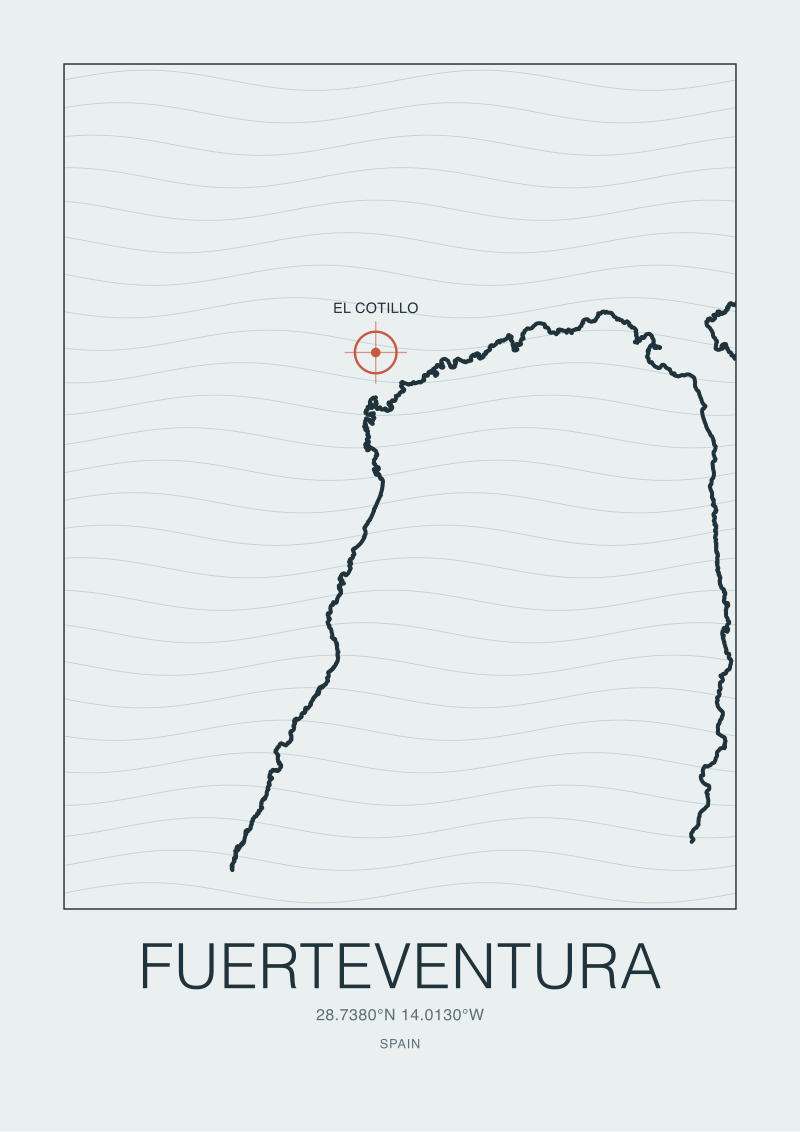
Fuerteventura's western shelf is a different bathymetric object. The island is volcanic, its western drop-off steeper and reef-fringed rather than shelved. El Cotillo receives Atlantic swells that have crossed open water without significant continental shelf interaction, then meet a coastline of black reef and pale sand shaped by trade-wind-driven longshore drift. The same 14-second period that produces a shoaling, top-loaded wall at Ribeira d'Ilhas produces a faster, hollower reef wave at El Cotillo, because the ratio of wave energy to depth is negotiated differently in the last hundred metres.
The lesson is not that one coast is better. It is that "swell" arriving at a shore is an input; the coast is the operator; the wave is the output. Change the operator and the same input becomes a different wave.
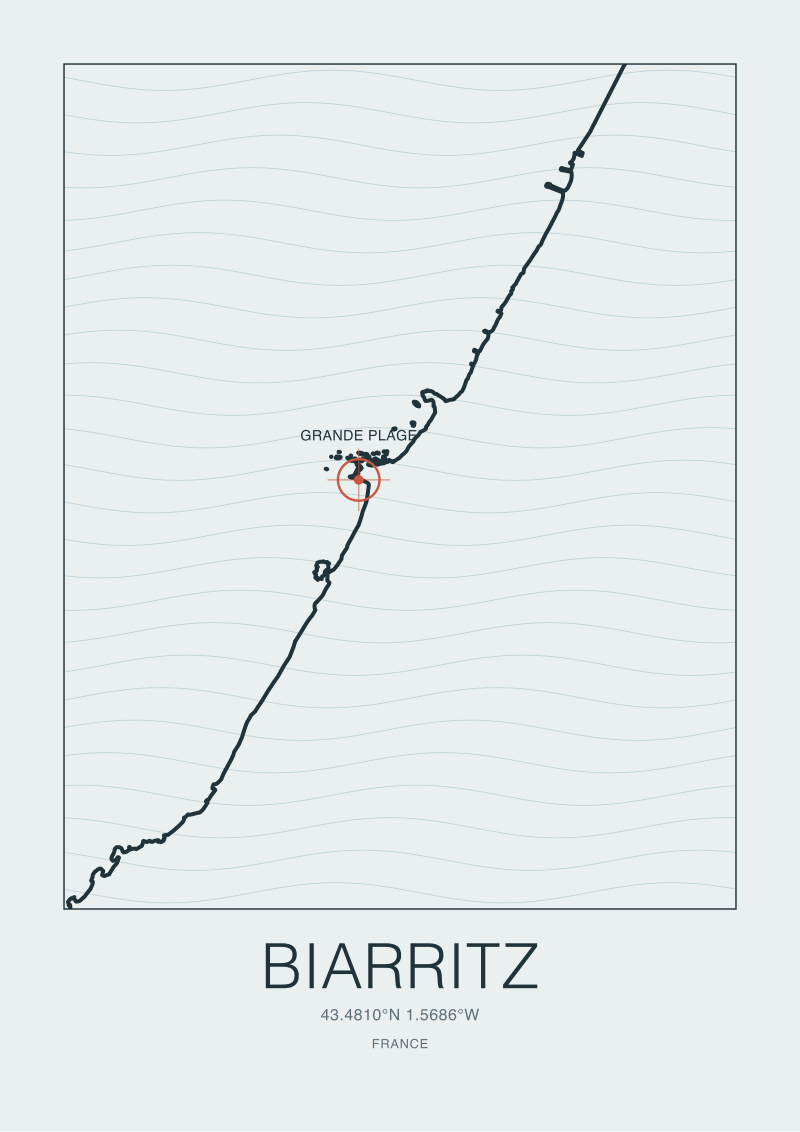 Biarritz
The print from this article · from €29.95
View the print →
Biarritz
The print from this article · from €29.95
View the print →
Finding #4: Biarritz Shows Why Swell Arrives Sorted, Not Raw — Refraction Is a Filing System
Grande Plage at Biarritz (43.49°N, 1.56°W) faces west-northwest into the Bay of Biscay. The bay's bathymetry — a gradual continental shelf broken by the deep Capbreton Canyon further north near Hossegor — refracts incoming swells before they reach the sand.
Refraction is what happens when a wave crest interacts with variable depth: the part of the crest in shallower water slows, the part still in deeper water keeps its speed, and the crest rotates to align more parallel to the isobaths. By Snell's law adapted for water waves, sin(θ₁)/C₁ = sin(θ₂)/C₂, where θ is the angle between crest and bathymetric contour. A 14-second swell arriving at Biarritz from 290° in deep water can rotate 15 to 25 degrees over the shelf before it reaches the shore, arriving more parallel to the beach than the raw offshore direction would suggest.
This is why Biarritz was, in 1957, the coast on which continental European surfing formalised: not because Biscay is the biggest ocean in the world, but because its shelf does consistent refraction work on incoming swell, filing raw wave directions into a narrower band of arrival angles at the sand. A coast that refracts well is a coast that produces surfable waves from a wider range of offshore conditions. The town's beach became a surf town because the shelf beneath it acts as an editor, not because the ocean in front of it is unusual.
A comparison of what each coast does with the same 14-second swell:
| Coast | Facing | Shelf character | What the 14s swell becomes | Dominant editing mechanism |
|---|---|---|---|---|
| Biarritz (Grande Plage) | WNW | Gradual continental, ~40 km wide | Beach-break waves, refracted parallel | Shelf refraction |
| Hossegor (La Gravière) | W | Shelf broken by Capbreton Canyon | Fast, top-loaded beach-break peaks | Canyon-directed focusing |
| Ericeira (Ribeira d'Ilhas) | WNW | Narrow shelf, ~15 km to 200 m | Shoaling reef point | Rapid shoaling on reef |
| Fuerteventura (El Cotillo) | W | Volcanic drop-off, minimal shelf | Hollow reef wave, less refraction | Direct deep-to-shallow transition |
What This Does NOT Prove
This piece does not prove that any of these coasts is "better" than any other. Better is a function of what the reader wants — a long shoaling wall, a hollow reef section, a forgiving beach face — and the physics we have laid out is agnostic on that preference. Nor does it prove that the equations here forecast a specific session; deep-water dispersion relations are idealised, and the real ocean is more granular than a textbook.
It also does not cover three things that belong to other pieces. It does not address swell interaction with tide, which changes the effective depth at the breaking point and therefore the wave shape. It does not address wind — offshore, onshore, or cross — which sculpts the wave face independently of the swell that produced it. And it does not address the seasonal storm-track climatology that determines how often each of these coasts receives long-period energy in the first place. Each is a separate reading.
The Takeaway
Swell, in surfing, means a wave train old enough to have escaped its wind and long enough to feel the coast before it arrives. Everything else — where it breaks, how it breaks, which coast makes it beautiful — is the shelf doing its work.
FAQ
What period counts as "swell" versus "wind sea" for a surfer?
The working threshold in physical oceanography is around 8 seconds. Below that, a wave train is usually still coupled to its generating wind and behaves as local sea — short, disorganised, steep. Above roughly 10 seconds, the train has typically outrun the wind that made it and is propagating as a decaying, dispersive swell. The best surf waves at coasts like Hossegor and Ericeira tend to arrive at periods of 12 to 18 seconds; anything at 20 seconds or above is a long-fetch southern-hemisphere or deep-North-Atlantic event.
Why does the same swell make different waves at different beaches?
Because the coastline is the operator, not the input. Two beaches receiving the identical 14-second swell will produce different waves depending on their shelf width, seabed slope, reef versus sand composition, and the angle their shoreline makes with the incoming crest. Ericeira's narrow shelf shoals the swell rapidly over reef; Fuerteventura's volcanic drop-off transitions the same energy from deep to shallow in a shorter distance. The wave is what the coast returns, not what the ocean sent.
How is group velocity different from wave speed, and why does it matter?
An individual crest in deep water travels at gT/2π. The energy of the wave train, however, travels at half that speed — group velocity, gT/4π. It matters because forecasting where and when a swell arrives is a group-velocity problem, not a crest-speed problem. When a storm 2,500 kilometres offshore sends energy toward the Landes, the leading long-period components reach Hossegor at roughly Cg, not C. Confusing the two produces arrival estimates that are wrong by a factor of two.
Why did European surfing start at Biarritz specifically?
The commonly cited year is 1957, when Peter Viertel brought a board to the Basque coast during a film shoot. But Biarritz took root because the Bay of Biscay's shelf refracts Atlantic swells into a narrower, more consistent band of arrival angles at Grande Plage, and because the beach faces roughly the direction from which most winter swell approaches. The town became the seed of continental surf culture because the physics of the shelf beneath it favoured the sport, not because the introduction was symbolic.
Does a bigger swell always mean bigger waves at the beach?
No. Significant wave height offshore is only one input to what breaks at the sand. A large but short-period swell can shoal into a mushy, closing-out shore-break, while a smaller long-period swell can produce clean, ordered, larger-feeling walls because it interacts with the seafloor over a wider zone and refracts more coherently. Surfers at reef-dependent coasts like Ribeira d'Ilhas learn quickly that period, direction and tide can matter more than raw offshore height.
What is the Capbreton Canyon and why does it affect Hossegor?
The Capbreton Canyon is a submarine canyon that cuts eastward into the continental shelf almost to the shoreline just north of Hossegor. Because wave speed depends on depth, swell crests passing over the canyon travel faster there than over the surrounding shelf, and the crest bends. That bending focuses wave energy onto specific sandbars along La Gravière and neighbouring beaches. Hossegor's reputation as a heavy-wave beach-break is largely a canyon story: the shelf immediately in front of the pines does bathymetric focusing that other stretches of the Landes coast do not.
Can this physics predict a specific day's surf at these coasts?
Not on its own. Dispersion relations and refraction equations describe how a swell of known period and direction will behave on a known shelf, but they assume an idealised ocean. Real forecasting layers on storm-track modelling, high-resolution bathymetric grids, tide phase and local wind. What the physics does give is a reading framework: knowing why Biarritz refracts, why Hossegor focuses, why Ericeira shoals and why El Cotillo transitions deep-to-shallow, a reader can interpret any forecast for these coasts more accurately.
Where can I see these coastlines drawn to scale?
The studio prints each of these coasts — Biarritz, Hossegor, Ericeira, Fuerteventura — from the same OpenStreetMap coastline data referenced in the methodology above, at a scale that shows the shelf geometry the article describes. They live in the /shop/, one print per coast.
New breaks and 10% off your first print.
One email now with your code. No noise after.