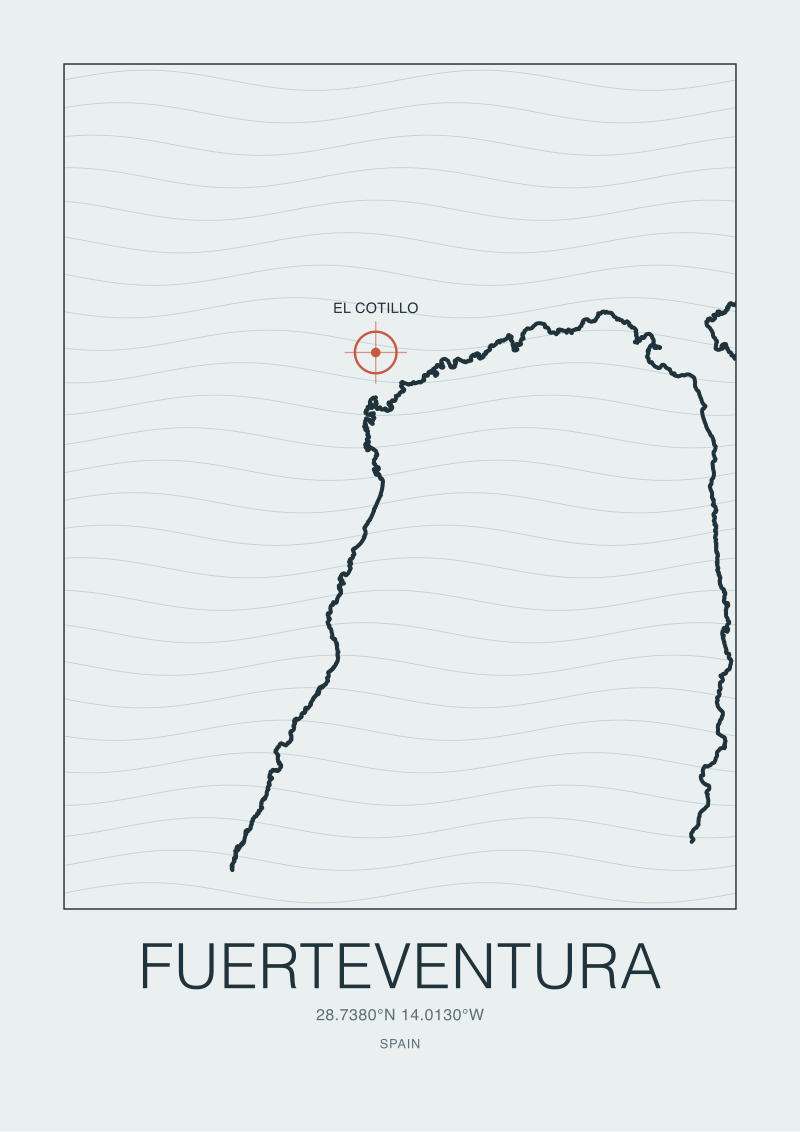
On the studio bench this month, the file open most often is the El Cotillo shelf — Fuerteventura's northwest coastline traced from OpenStreetMap's natural=coastline data at roughly 28.6745° N, 14.0125° W. For the reader hanging a Fuerteventura coast print in a room that faces the Atlantic, or breathes anything close to it, our default is unframed. The likely objection is fair: bare paper on plaster can read as unfinished, a poster instead of a print. We are going to defend the unframed default across four points grounded in what the coastline is doing on the page, and then name the one apartment where the frame wins outright.
Before we start defending, we owe the opposite view a proper hearing.
The Steel-Man: Where a Frame Genuinely Earns Its Keep on a Fuerteventura Print
There is one room type where we would frame the El Cotillo print without hesitation, and pretending otherwise would be dishonest. It is the inland formal room: a north-facing sitting room in a European city apartment, no window within twenty metres of the sea, walls in a mid-value paint that is doing serious work of its own — deep green, warm ochre, a dusty rose. In that setting, a piece of unmounted cotton paper on a tack floats in a way that reads as provisional. The room is speaking in furniture with legs, in cornices, in a joinery register that expects everything on the wall to have a beginning and an end. A wide oak or blackened ash frame answers that grammar. It says: this print has been chosen, mounted, and set here on purpose.
There is a second case, narrower but real: the print is going into a rental you own, or a room where children and their friends pass close to the wall. Paper without glass will not survive a decade of shoulders, curious fingers, or the aerosol of a cleaning routine that includes solvents. Framed under glass, the same print becomes a fifteen-year object. That is a legitimate argument. If your Fuerteventura print is going into a hallway of a coastal short-let, we would frame it, and we would specify UV-filtering acrylic rather than glass so it survives the flight down.
Everything else — and it is most rooms most of our readers write in from — points the other way.
Unframed Reads as Coastline. Framed Reads as Object.
The El Cotillo file is doing something specific on the page. The peninsula's northwest edge curls out into the Atlantic in a shallow concavity; the reef arcs sit slightly proud of the shoreline; the lagoons north of the town read as a broken series of white voids where the coastline data steps inland. When we print this file at A2 or larger, the coast line is thin — a single hairline traced by the Overpass query — and the rest of the sheet is the negative space of ocean and interior. The composition is almost entirely about that line and the emptiness around it.
A frame introduces a second, competing edge. The moment you set the print inside a rectangle of oak, the eye stops at the moulding. The Atlantic no longer extends off the paper into your peripheral vision and your imagination of what lies west of the Canaries; it stops at four inches from the coastline and becomes a rectangular decoration. The peninsula, which on bare paper reads as one specific vertebra of a much longer Iberian-African coastal system, becomes a picture of a peninsula.
Unframed, held to the plaster with archival hinges or steel bulldog clips at the top corners, the print behaves differently. The paper's own edge — softly deckled on our mould-made stock — dissolves against a pale wall. The reader's eye reads the coastline first and the sheet edge second, in that order. The coast becomes the object; the paper becomes atmosphere. That is the difference between a coast print and a framed picture of a coast, and for a studio whose whole practice is drawing coastlines before writing about them, the difference is not decorative. It is the argument.
 Fuerteventura
The print from this article · from €29.95
View the print →
Fuerteventura
The print from this article · from €29.95
View the print →
El Cotillo's Light Is the Problem With Glazing
Fuerteventura sits at roughly 28.6° N. That is a subtropical latitude — closer to the Sahara than to Lisbon — and the practical consequence for a print of El Cotillo is that the reader hanging it very often lives, or aspires to live, in the kind of room where Canarian light is a design constraint. Whitewashed walls, south or west aspect, unshaded midday sun coming in low across the sea in winter. The reason people buy coast prints of Fuerteventura is precisely that they want the room to hold that latitude of light.
Glazing fights that light. Ordinary picture glass has a reflectance of around eight percent per surface, which means a framed print hung opposite a bright window becomes, at certain hours, a mirror of the room behind the reader. The coastline disappears under a specular sheet of white. Anti-reflective museum-grade acrylic exists — it drops surface reflection under one percent — but on a large-format Fuerteventura print, the acrylic sheet alone is frequently more expensive than the print itself, and it scratches on a soft cotton cloth. We have watched customers pay for the frame, arrive home, and discover that between 11:00 and 15:00 the print they wanted is unreadable.
Bare paper does not have this problem. Uncoated cotton stock reflects diffusely — the surface scatters incoming light across a full hemisphere rather than bouncing it back in one direction — and at the latitudes where our readers actually hang these prints, that matters more than any conservation argument in either direction.
| Dimension | Unframed print, hinged to wall | Framed under standard glass | Framed under museum acrylic |
|---|---|---|---|
| Surface reflectance in bright room | Diffuse; readable at all hours | ~8% per surface; mirrors room 11:00–15:00 | <1%; readable throughout day |
| Added cost vs print alone | None to nominal (hinges, clips) | Moderate frame + glass cost | Frame + acrylic often exceeds print price |
| Weight for A2 or larger | Under 200g | 2–4 kg with moulding and glass | 1.5–3 kg |
| Behaviour in salt-air room | Breathes with ambient humidity | Traps moisture at glass/paper interface | Same trap; slower to fog |
| Reads as | A piece of coastline | A framed picture of a coastline | A framed picture, better lit |
The table is not a scoreboard. It is a description of what each format is doing on the wall.
The Salt-Air Rooms Where Bare Paper Outlives a Frame
This is the counterintuitive point and the one worth spending words on, because the standard framing argument runs the other way. The received wisdom is that glass protects paper from humidity. In a coastal room, the received wisdom is wrong.
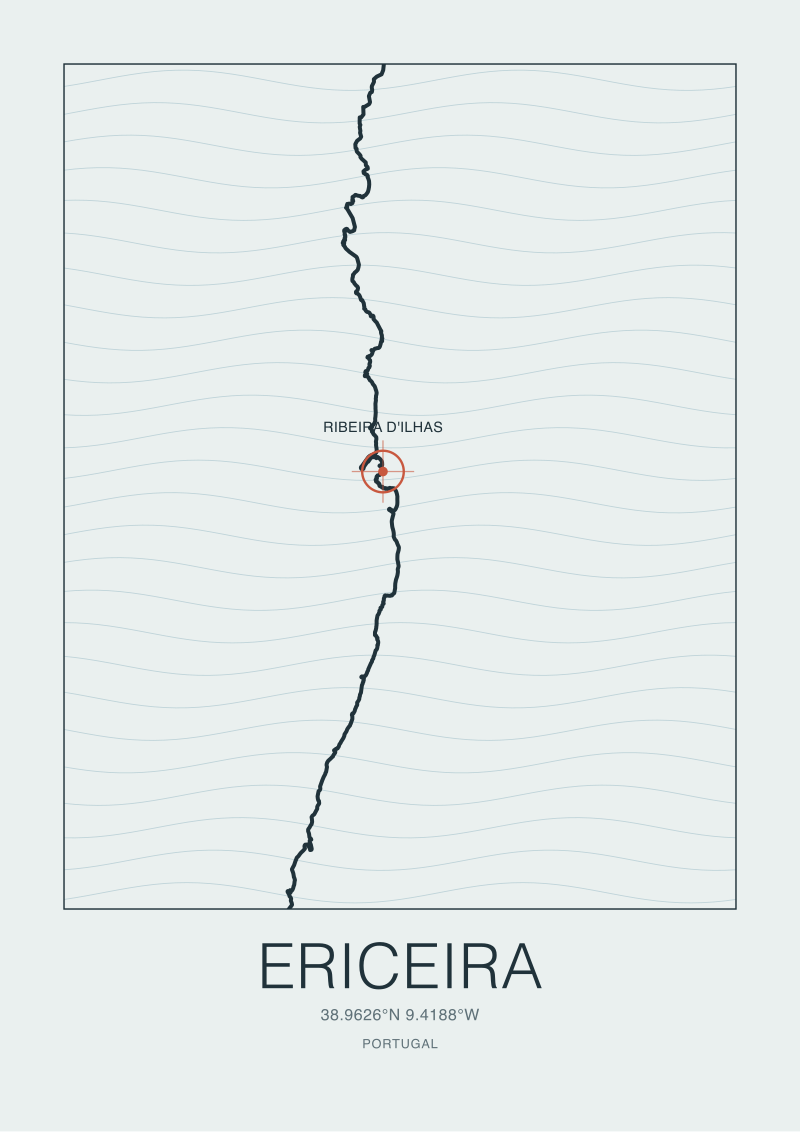
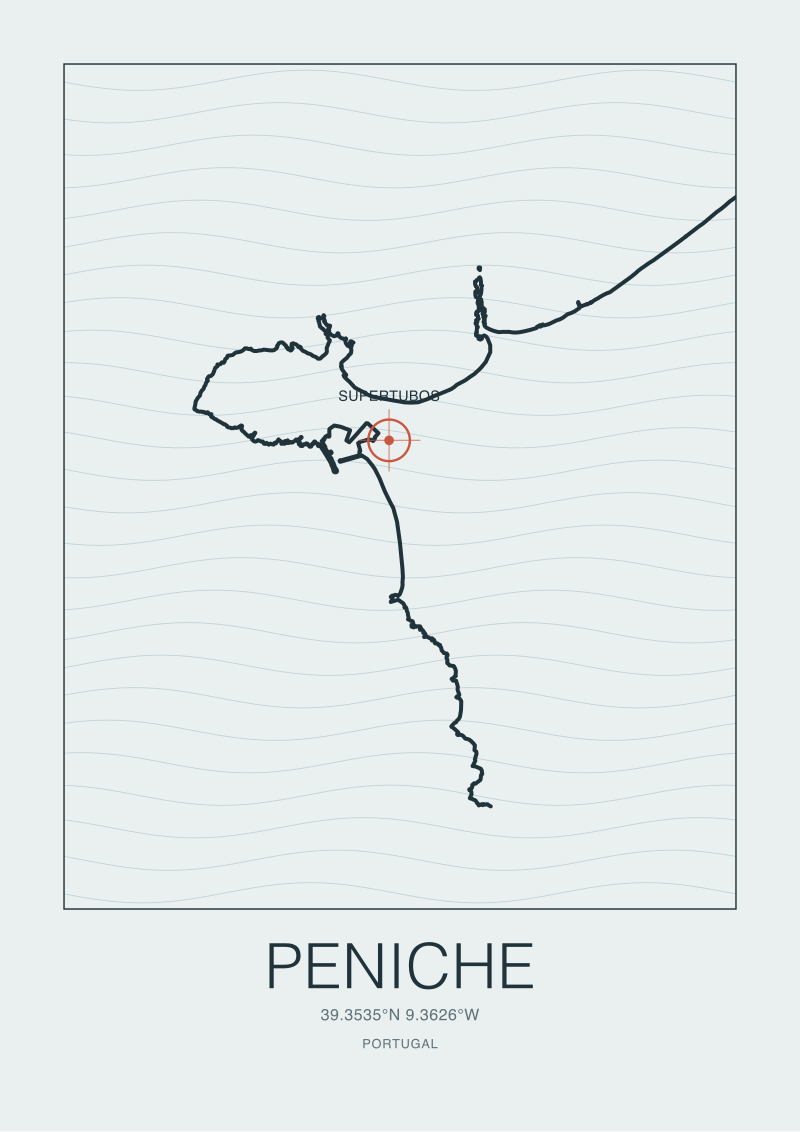
A sealed frame — moulding, backing board, glass or acrylic front — creates a small closed volume of air around the sheet. In a room that is dry and temperate, that volume is a benign microclimate. In a room three streets from the Atlantic in Peniche, or a top-floor flat in Ericeira, or anywhere the reader can smell the sea from the balcony, that volume becomes a humidity trap. Salt-air is not neutral moisture; it carries dissolved chloride, and chloride condenses on the coolest surface in the sealed system, which is almost always the inside face of the glass. Over months, the trapped humidity cycles between the paper and the glazing. The result is foxing along the corners, mount-board discolouration where the print meets the bevel, and in the worst cases a fine mist of surface chloride you can feel with a fingertip when you eventually take the frame down.
Unframed paper does not do this. Cotton stock in open air equilibrates continuously with the room. In a coastal apartment where the ambient humidity might sit at sixty percent for weeks in autumn, the sheet accepts and releases moisture without ever holding a gradient. It also stays cleaner than most people expect: coastal air is remarkably low in particulate compared to urban interiors, and the studio has hung archival cotton prints in kitchens forty metres from the shore that have remained visibly unchanged after seven years. The wood of an oak frame, meanwhile, warps in the same room within eighteen months.
There is a conservation logic here that runs against gallery convention. Galleries frame because they have to move work, ship it, insure it, and hang it in climate-controlled rooms where the frame is the correct answer. A reader hanging one Fuerteventura print for their own apartment for the next decade is not operating in that logistical grammar. They are operating in the grammar of a piece of paper that will live in one room and share its weather.
 Ericeira
The print from this article · from €29.95
View the print →
Ericeira
The print from this article · from €29.95
View the print →
What You Should Actually Do
If your room is coastal — anywhere the sea is a smell as well as a view — hang the El Cotillo print unframed. Order it on cotton stock in the largest size the wall will hold. Fix it with two archival photo corners or two matt-black bulldog clips at the top edge, hung from a single steel pin. Let the bottom edge move slightly in a draft; it will settle. Do not laminate, do not mount to foam-core, do not put anything between the paper and the wall. Once a year, take it down, wipe the wall behind it with a dry cloth, and rehang. You will not need to do more than that. The coast on the page will keep saying what it is supposed to say — that Fuerteventura is a shape, first, and a place, second.
If your room is inland, formal, and the walls are doing strong colour work of their own, frame the print in a plain, wide moulding — oak, blackened ash, or a warm-white painted timber — with a generous mount and no glass at all if the room allows it, or museum-grade acrylic if it does not. Skip the standard picture glass entirely; the reflectance problem is real even away from the Canaries. And if you are hanging the print in the room where it belongs most naturally — a room whose light or view or memory ties back to that coastline at 28.6745° N — the studio prints ship rolled from our shop, and they are drawn to be looked at bare.
FAQ
Does an unframed print curl badly on a wall over time?
On archival cotton stock at 300gsm or heavier, a print hung with two top corners settles into a very slight relaxation curve over the first few weeks and then stops moving. It does not progressively curl. Lighter poster papers do curl; the studio's default weight is chosen specifically to avoid that behaviour in domestic rooms.
Will bare paper yellow faster than framed paper in a sunlit room?
UV exposure fades any print, framed or not; glass filters roughly forty percent of UV, acrylic slightly less unless specified as UV-filtering. The larger fade risk in most rooms is direct midday sun on the sheet. Position the print on a wall that receives reflected daylight rather than direct sun, and both framed and unframed prints hold their pigment for a decade or more.
How do I actually attach an unframed print to a plaster wall?
Two archival photo corners at the top edge, held to the wall with a single steel pin behind each corner. For heavier sheets, matt-black bulldog clips at the top corners, hung from two picture pins spaced to the print width. Both methods leave no residue on the paper and no visible fixings from three metres.
Is museum-grade acrylic worth the price for a coast print?
For a formal inland room with strong ambient light, yes — it solves the reflectance problem that ordinary glass creates. For a coastal apartment, no; the humidity-trap problem is not solved by the acrylic, and the added weight and cost are not repaid by any conservation benefit the open-air alternative doesn't already offer.
What size Fuerteventura print works best unframed?
Bare paper reads best when it has enough scale to command the wall on its own — typically A2 or larger. Below A3, an unframed sheet starts to look tentative next to any furniture with mass; if the wall calls for something small, a small print is one of the few cases where framing genuinely does help the composition.
Does the studio recommend framing prints of other coasts differently?
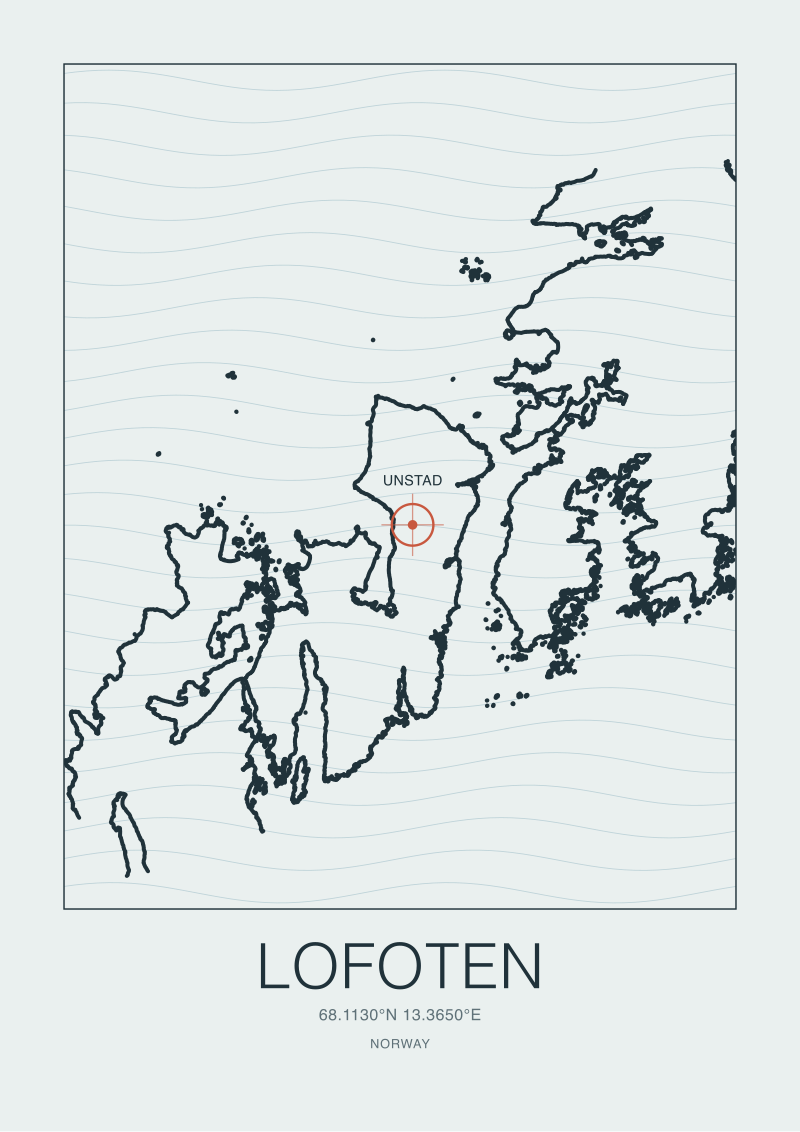
The framing calculus varies by latitude and by what the coastline is doing on the sheet. High-latitude coasts — Lofoten, north Cornwall — sit in softer light and tolerate glazing better than the Canaries. Very dense coastal drawings with a lot of ink on the page hold up better inside a frame than sparse ones. El Cotillo is at the sparse-and-subtropical end, which is why the unframed default is strongest here.
Can I hang the same print in a bathroom or a kitchen?
A kitchen away from the hob, yes. A bathroom, only with proper ventilation; steam that cycles daily against the sheet will eventually cockle the paper, framed or not. The studio's honest recommendation for very humid rooms is a smaller, cheaper print you can replace every few years rather than a large one you expect to keep forever.
How does the studio's own bench display these prints?
On the studio wall, the El Cotillo file hangs unframed, top-clipped, on a lime-washed plaster wall roughly four metres from a north-facing window. It has been in that position for over two years without protection, retouching, or visible change. That is the reference room the default is written for.
New breaks and 10% off your first print.
One email now with your code. No noise after.