At 6:14 on a February morning, four books on cold water surfing sat on the studio table, all bought in the last month, all opened to their Thurso chapters. Three of them called the place lonely. Two called it moody. One called it a pilgrimage. Not one, in the pages we read that morning, actually drew the reef. Thurso is the North Atlantic's most-photographed cold water break in Britain, and the literature about it keeps reaching for the same three adjectives before it reaches for the map. What follows is a reading list ranked by how much of the coast the book actually shows you.
The Books That Actually Draw the Coast Instead of Praising It
The book that earned its shelf space this winter was Chris Nelson and Demi Taylor's *Cold Water Souls*. It is not perfect. It gestures at spirituality more than we would like, and its cover treatment leans harder into mist than into map. But when it arrives at the Caithness coast, it does the one thing the rest of the pile refuses to do: it describes the rock. It tells you the wave at Thurso East reels along a slab of flagstone laid nearly flat under the sea, that the reef is a geological artefact and not a metaphor, that the town sits behind it because the town has been there longer than surfing has been a word in English. This is what we mean when we say a book draws the coast. It treats the shore as a shape first and a mood second. Everything else — the wetsuit rituals, the North Sea temperature, the wind direction on the day the writer arrived — is subordinate to the geography that made the wave possible in the first place.
The second book that survived the cull was a Footprint surfing guide to Britain and Ireland from the same lineage. Not literature. That is the point. A guide that names beaches, gives coordinates, marks the difference between a right-hand reef and a beach break with sandbars that migrate, and admits — usefully — when it does not know something. The register is flat, almost dry, and it is a relief. When a guide tells you Thurso is a right-hand reef break that works best on a north swell in a light southerly wind, it is not telling you what to feel. It is telling you what shape you are looking at. This is the reference layer every good coastal library needs underneath the essays. Without it, the essays float.
The third that stayed on the shelf was harder to place. It was a photography book, or a book that was mostly photographs with captions, and the captions were the reason it worked. Someone had bothered to write, under each spread, where on the coast the frame was made and what tide had been running. Not always the wave height, not always the swell direction — those are the numbers that date fastest and matter least to a book — but the location, the season, the light. A cold water photography book that respects location as a fact rather than as ambience is doing more cartographic work than most prose. Compare this against the pile of surf photography books where every caption reads "somewhere on the Scottish north coast, winter" and you understand why the good ones stand out. Location is not a mood. It is a coordinate, and coordinates are what a coastal reader shows up for.
The Ones That Sold Thurso as a Vibe and Forgot the Bathymetry
Now the fun part. The pile that did not survive.
There is a strain of cold water surf memoir — you know the one — that opens with the writer's first cold-hands moment and closes with a paragraph about what the sea taught them about themselves. Between those bookends there is often a chapter on Thurso, and the chapter is almost always identical across authors. The train from London or the flight to Inverness. The drive north past Helmsdale. The arrival at the caravan park. The first sight of the wave from the clifftop. The word "lonely." The word "moody." The word "pilgrimage." A local who is either taciturn in a wise way or friendly in a way that surprises the writer. The wetsuit is 5/4/3. The water is described as "a shock." The wave, when the writer eventually paddles out, is described as "the best of my life," or "humbling," or occasionally both in the same paragraph.
We are not being cruel for sport. There are good sentences inside this template — the genre has been running long enough to produce them. The problem is that the template has replaced the coast. The reader who came to the page wanting to understand why a wave breaks the way it does at Thurso East, and not at Brims Ness half an hour down the road, and not at Sandside further west, is given three adjectives and an anecdote about wetsuit gloves. The bathymetry — the slab of flagstone, the way the reef edge angles into the prevailing north swell, the reason the wave holds shape at size when other British reefs close out — is missing because the writer never looked at it. They looked at their own reaction to it.
One book in the pile, which we will not name because there is no honour in punching down, spent seventeen pages on the writer's relationship with cold and one paragraph on the actual geometry of the reef. Another book quoted three separate locals saying variations of "you should have been here yesterday." A third book compared Thurso to somewhere in Iceland it clearly resembled in no meaningful geographic way — different rock, different swell window, different latitude, different everything — but the comparison sounded good on the page. This is how surf writing becomes a genre in the pejorative sense. It stops describing places and starts recycling reactions to them.
The tell is always the maps. The books that respect the coast include maps, even bad ones — a rough sketch, a reproduced Admiralty chart cropped tight, a schematic of the reef with the direction of the wave marked. The books that treat the coast as a backdrop for personal transformation do not include maps, or they include one decorative map at the front that shows you the shape of Scotland and nothing else. When we sort a shelf, we now sort it by cartographic density. The books that draw the coast, in any form, go on the left. The books that only feel the coast go on the right. The right side gets thinner every year, because we keep giving those books away.
What Belongs on a Cartographer's Cold Water Shelf When the Sea Is 8°C
The reading list we would build for someone starting fresh on the North Atlantic's cold water coasts — and Thurso is the anchor of that shelf, but not the whole of it — begins with *Cold Water Souls* for the essayistic ground it covers well, pairs it with a current Footprint or equivalent guide for the reference layer, adds one photography book chosen for caption discipline rather than image count, and then does something the surf-memoir pile rarely thinks to do: it leaves surfing behind for the next three volumes.
An Admiralty chart of the Pentland Firth belongs on this shelf. It costs less than most of the books, it is more accurate than any of them, and it explains — in bathymetric contours and tidal-stream arrows — more about why Thurso surfs the way it does than a hundred pages of essay. The Firth is one of the strongest tidal races in Europe. That fact governs the local sea state, the sediment transport, the fetch geometry of a north swell arriving from the Arctic, and it is invisible in every book on the shelf except the chart. A shelf without the chart is a shelf that has decided the sea is a feeling rather than a fluid.
A regional geology guide belongs on the shelf next. The flagstone that makes Thurso East a world-class right-hand reef is Caithness flagstone, a Middle Devonian sedimentary rock laid down in a lake system nearly four hundred million years ago, split by the local quarrymen for a century before it split for waves. The book that tells you this is not a surf book. It is a Scottish geology field guide, and it is, by a distance, the most useful thing you will read about why the wave exists. The reef is older than the sport by every meaningful order of magnitude. A cold water reader who does not want to know that is a reader we cannot help.
Third: a local history of Caithness or of Thurso town. Not because history is a moral duty but because the town's fishing, quarrying, and nuclear-adjacent past have shaped the coastline you are looking at — the harbour walls, the shore access, the reason certain paths exist and others do not. A book about the town is a book about the coast, because the coast is not empty. Every cold water surf memoir treats Thurso as a wilderness with a wave in it. It is not. It is a working town of around eight thousand people, on a coast that has been mapped and worked and lived on for a long time, and the wave breaks in the middle of that context, not in a vacuum.
When these six items sit together on the shelf, something interesting happens. The essays get better because they are checked against the chart. The photographs get better because they are located against the geology. The guide gets better because it is read against the history. And Thurso, on the page, finally looks like the place it is on the map: a right-hand reef over Devonian flagstone at the mouth of a tidal firth, in a town, in a country, at a latitude where the sea in February is genuinely eight degrees and genuinely worth showing up for. That is the coast the studio is trying to draw. It is also, we suspect, the coast the best of the books were quietly trying to describe all along.
This piece started as a straightforward book review and turned, halfway through the second H2, into an argument about what surf writing is for. That was not the plan. The plan was to say which books were good. What kept happening, as we sorted the shelf, was that the good books were the ones that treated the coast as a place that existed before the writer arrived and would exist after they left — and the ones we kept setting aside were the ones that could not quite believe that. If the reading list matters, it matters because the shelf is a small model of the coast itself. What you leave off it is what you have decided the coast is not.
None of this tells you what to actually do when you stand on the clifftop at Thurso East for the first time and look down at the reef. That question — what the coast asks of the person who has finally arrived at it, after all the reading — is where the next piece has to start, and it is not where this one ends. Our shop at see the Biarritz print has the coastline print we drew of the Pentland Firth while writing this. Everything else is on the shelf.
FAQ
Is Thurso actually the best cold water surf spot in Britain, or is that a book-marketing line?
"Best" is a claim the literature keeps making without defining terms. What is defensible is that Thurso East is a consistent, well-shaped right-hand reef break that holds size in a way most British reefs do not, and that it sits inside one of the most photogenic and geologically distinctive stretches of the Scottish north coast. Whether that makes it "the best" depends on whether you rank waves by consistency, quality, accessibility, or coastal character. The books tend not to declare which they mean.
What temperature is the sea at Thurso, and does it really need a 5/4/3 wetsuit?
North coast Scottish sea surface temperatures typically sit in the range of roughly 7 to 9°C in late winter and early spring, rising into low double digits by late summer. A 5/4/3 wetsuit with boots, gloves and a hood is standard local kit for the coldest months. The surf-memoir genre tends to over-dramatise the cold as if it were exotic; the guide-book layer treats it as a specification, which is more useful. Both are looking at the same water.
Why does Thurso East break the way it does — is it a beach break or a reef?
Thurso East is a right-hand reef break over a slab of Caithness flagstone, a Middle Devonian sedimentary rock that lies close to horizontal under the sea just off the town. The reef shape refracts incoming north swell into a long, orderly right-hander that holds its form as the wave grows. This is different in character from the beach-break coasts of, for example, Hossegor in France, where the wave shape is negotiated by shifting sandbars over deep offshore trenches.
Are there other cold water surf coasts worth reading about alongside Thurso?
Yes, and the honest reading list ranges wider than Britain. Ericeira in Portugal offers a warmer-water counterpoint on the same Atlantic — its reserve status has produced a strand of literature about coastal protection that the cold water books mostly lack. Biarritz in France is where organised European surf culture took root in the late 1950s, which gives the historical layer any serious surf-coast library needs. A shelf that only reads Thurso reads Thurso poorly.
Which surf books should I skip?
Any book whose Thurso chapter can be summarised by the words "lonely," "moody," and "pilgrimage" without loss of information. Any book with no maps, no coordinates, and no reference to the underlying geology of the reef. Any book that quotes three different locals saying "you should have been here yesterday" as if the line were newly discovered. These are template books; they exist to sell the reader a mood they arrived with already.
Do I need an Admiralty chart to enjoy a surf book?
No, but you will enjoy the good surf books more if you have one open beside them. The chart shows tidal streams, seabed contours, and the actual geometry of coasts that prose can only gesture at. Reading an essay about the Pentland Firth without the chart is like reading a music review without hearing the record. It is possible; it is just thinner than the alternative.
Is there a Salt & Swell print of Thurso or the Caithness coast?
Yes — we drew the Pentland Firth coastline from OpenStreetMap data while researching this piece, and the print is in our shop at /shop/. It is a coastline map, not a surf poster: no wave icons, no spot labels, just the shape of the shore that makes the waves possible. That is the only commercial recommendation this piece will make.
Why is a coastal cartography studio ranking books at all?
Because we sort a shelf the same way we sort a coastline: by what is actually there. The books that draw the coast belong together. The books that only feel the coast belong elsewhere. Publishing the ranking is a way of showing the reader how we look at the whole enterprise — as a mapping problem first and a literary one second. If that framing is useful, the shelf you build next will be a better one than the shelf we started with.
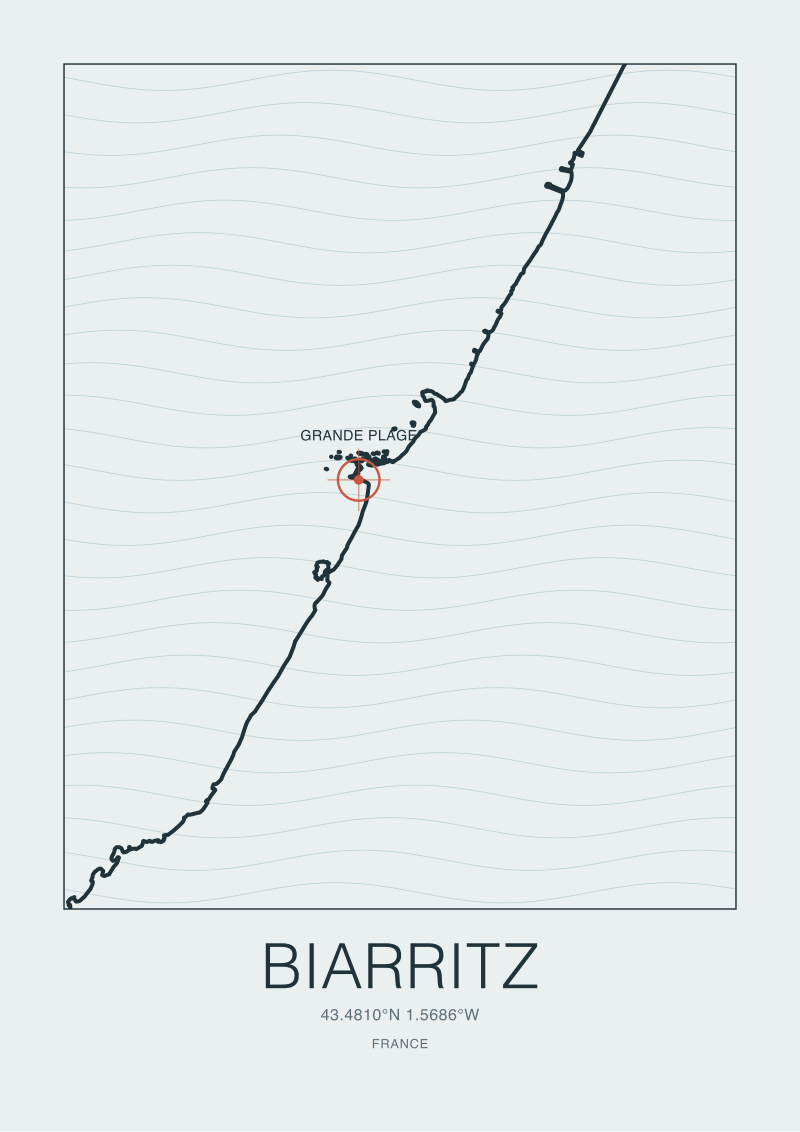 Biarritz
The print from this article · from €29.95
View the print →
Biarritz
The print from this article · from €29.95
View the print →
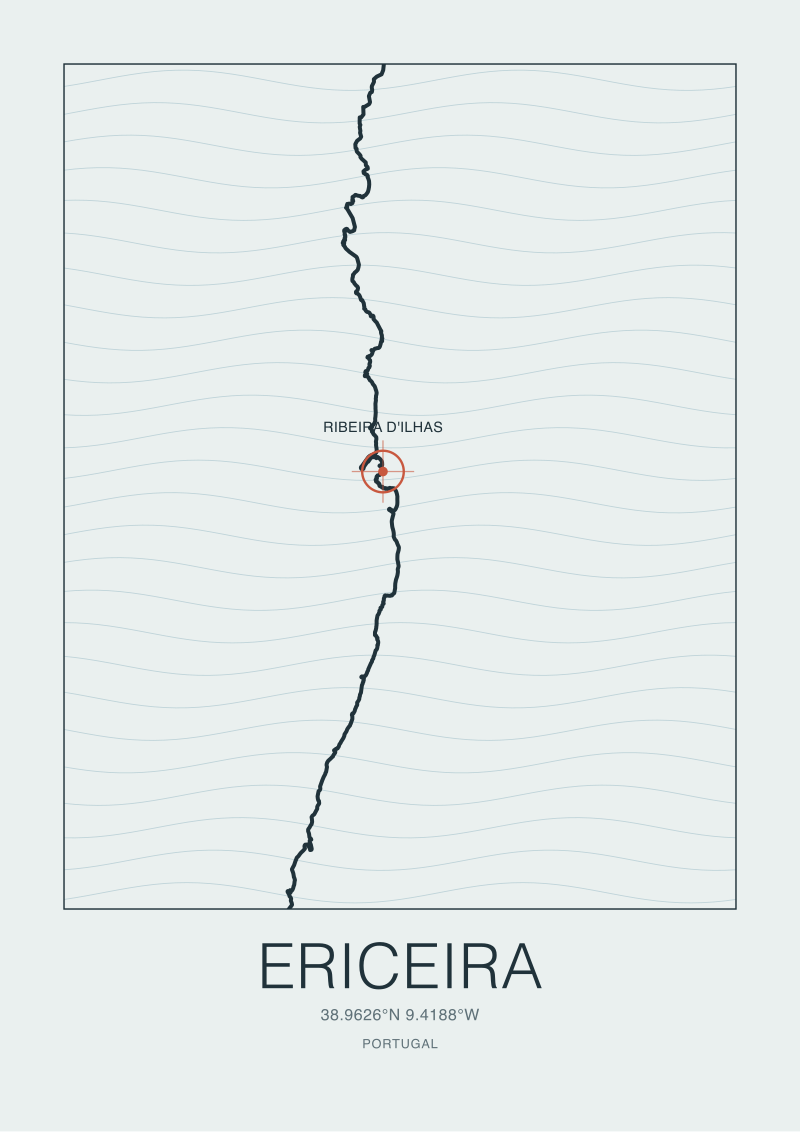 Ericeira
The print from this article · from €29.95
View the print →
Ericeira
The print from this article · from €29.95
View the print →
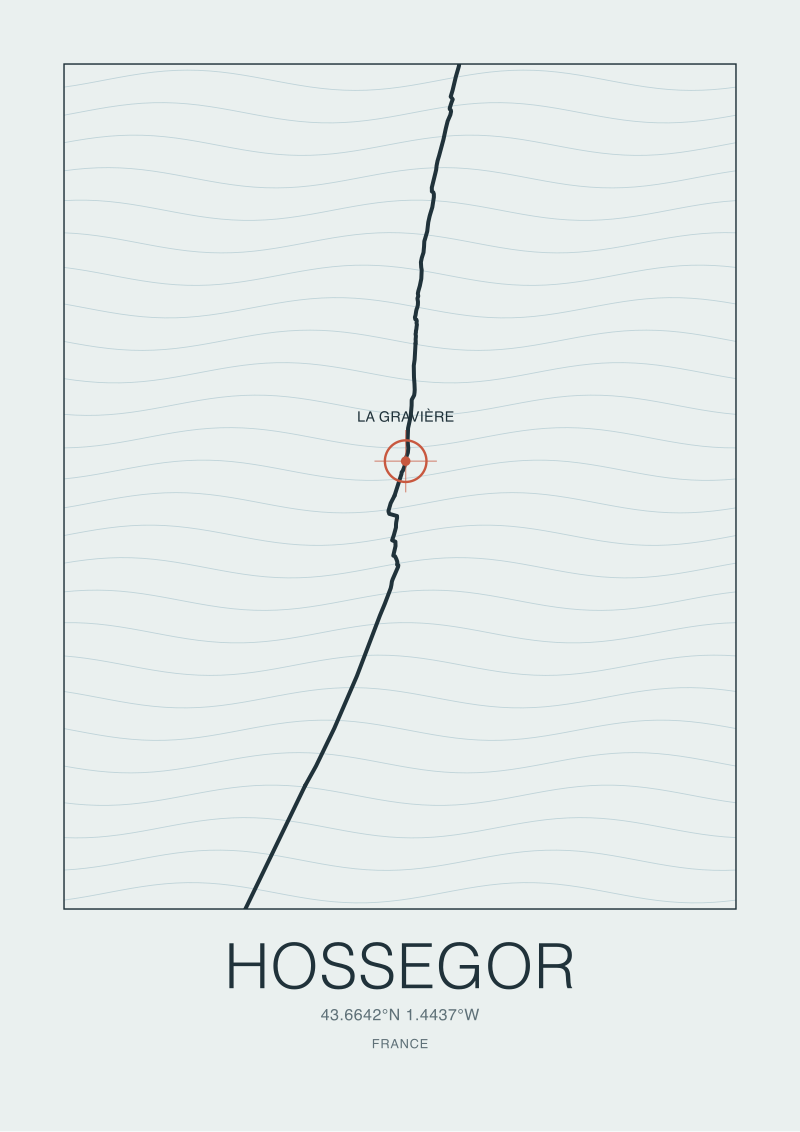
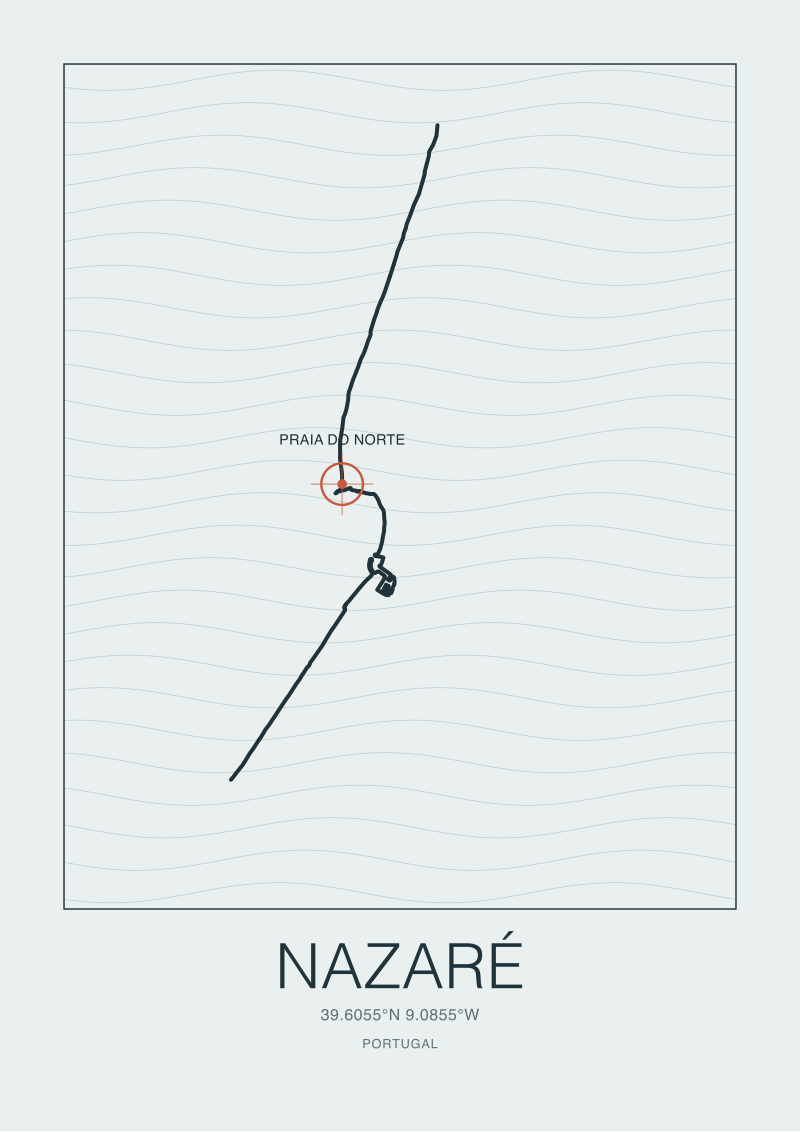
New breaks and 10% off your first print.
One email now with your code. No noise after.