You do not need to surf to read a coast. But to read European surf culture — where it started, why it clustered where it did, what the towns inherited from it — a small vocabulary helps. Biarritz sits at 43.4853°N, -1.5584°E, a Basque town on the Bay of Biscay whose Grande Plage became, in 1957, the accidental first address of the sport on the continent. The terms below are the ones a studio uses when it draws that coast: some geographic, some cultural, all load-bearing.
Grande Plage
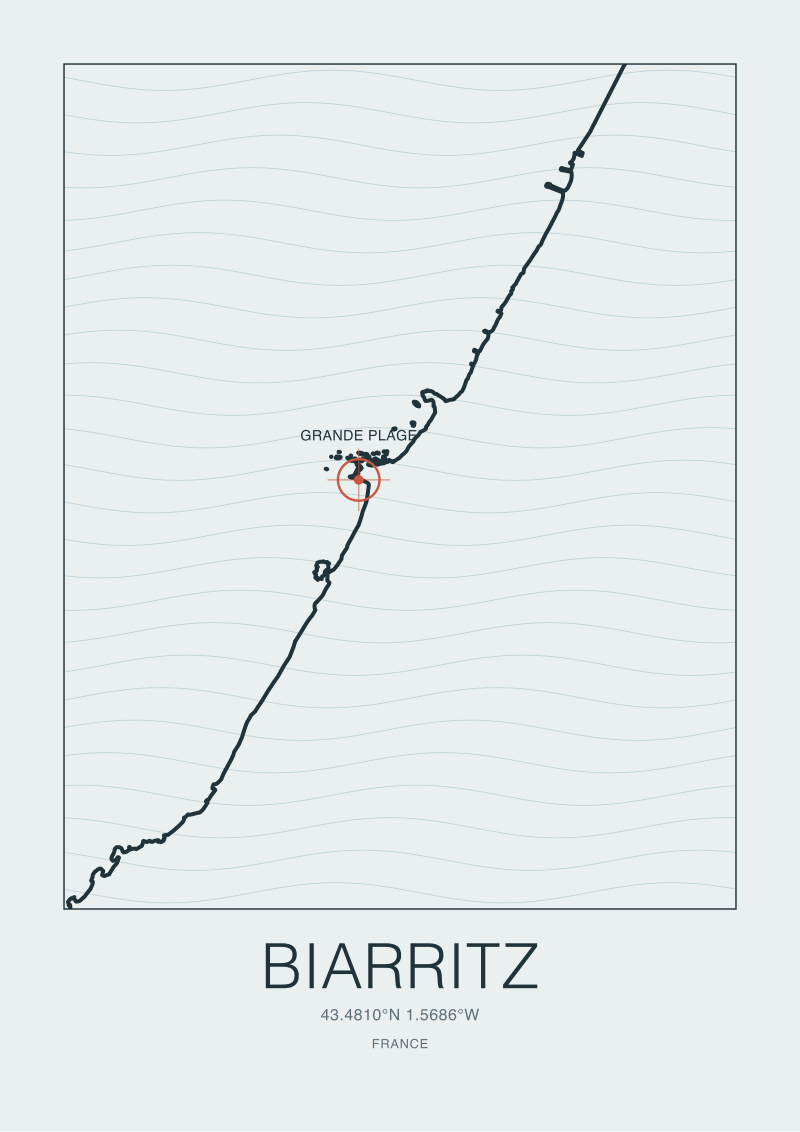
The Grande Plage is Biarritz's central beach: a shallow arc of sand pressed between the town's cliff-line to the south and the Pointe Saint-Martin headland to the north. On our coastline plates — drawn from OpenStreetMap's `natural=coastline` traces — it reads as the softest curve on an otherwise angular shore, the visual break between the Basque cliffs and the long dune-backed sweep that runs up toward Anglet and, beyond it, Hossegor.
Why the beach matters is not aesthetic. The Grande Plage is where the sport landed in Europe. Its sand faces roughly west-northwest, catches Atlantic swell almost head-on, and sits within easy walking distance of hotels, casinos, and — in 1957 — the film crews that would notice a man in the water with a board. The address is a piece of European surf history the way a specific pier or specific street corner can be a piece of any subculture's history. It happened here, not somewhere abstractly Basque.
Côte des Basques
Ten minutes' walk south of the Grande Plage, the coast turns. The Côte des Basques is Biarritz's second beach, tucked beneath the cliffs of the Plateau de l'Atalaye, exposed to the same Atlantic swells but at a different angle and — critically — with a very different seafloor. At high tide the beach almost disappears against its wall of rock; at low tide a wide, gentle apron of sand opens up.
For a studio drawing this coast, the Côte des Basques is where the surf story properly settles. Its longer, slower waves suited the heavy wooden boards of the late 1950s in ways the Grande Plage's shorebreak did not. The town's earliest surfers gravitated here, and the beach still reads today as the didactic beach of the Basque coast — the place people go to learn, to teach, to watch surf as a repeatable, patient activity rather than an event. The Grande Plage is the address. The Côte des Basques is the classroom.
 Biarritz
The print from this article · from €29.95
View the print →
Biarritz
The print from this article · from €29.95
View the print →
1957
1957 is the year European surf culture is dated from, and the year does real work in the record. The screenwriter Peter Viertel arrived in Biarritz to work on the Hemingway adaptation "The Sun Also Rises" and brought a surfboard from California. Local witnesses saw him ride waves off the town's beaches. The board stayed. A small circle of French, mostly Basque, adopters formed around it in the seasons that followed.
We treat 1957 the way a cartographer treats a datum — a fixed point from which distances are measured. Every claim about European surf as a continuous, self-aware scene rather than isolated incident traces back to this year. There were surely earlier moments — a plank, a body, a fisherman's improvisation — but the studio's job is to distinguish folklore from record. The record begins in Biarritz, in 1957, with a Californian screenwriter and a Basque town paying attention.
Point Break
A point break is a wave that breaks along a headland or rocky promontory rather than on an open beach. The swell hits the point at an angle, wraps around it, and peels progressively down the coast in one direction — usually giving a longer, more predictable ride than beach-driven waves.
The vocabulary matters because European surf coasts are unusually rich in point breaks. Northern Spain, Portugal, Ireland, and southwestern France all offer headlands where Atlantic swell bends around a piece of geology. Biarritz itself has point-break characteristics at its rockier edges, though its most famous beach — the Grande Plage — is closer to a beach break in behaviour. When our plates label a break as a "point," we mean something specific about the geometry of the shore: waves organised by rock rather than by sand, and therefore by geology on a timescale of millennia rather than by storms on a timescale of days.
 Hossegor
The print from this article · from €29.95
View the print →
Hossegor
The print from this article · from €29.95
View the print →
Beach Break
A beach break is a wave that breaks over a sandy seafloor, its shape determined not by fixed rock but by sandbars that shift with tides, storms, and season. The wave arrives with the same physics as at a point break — swell energy meeting shallower water and rearing up — but where it breaks, and how well, depends on where the sand happens to be that week.
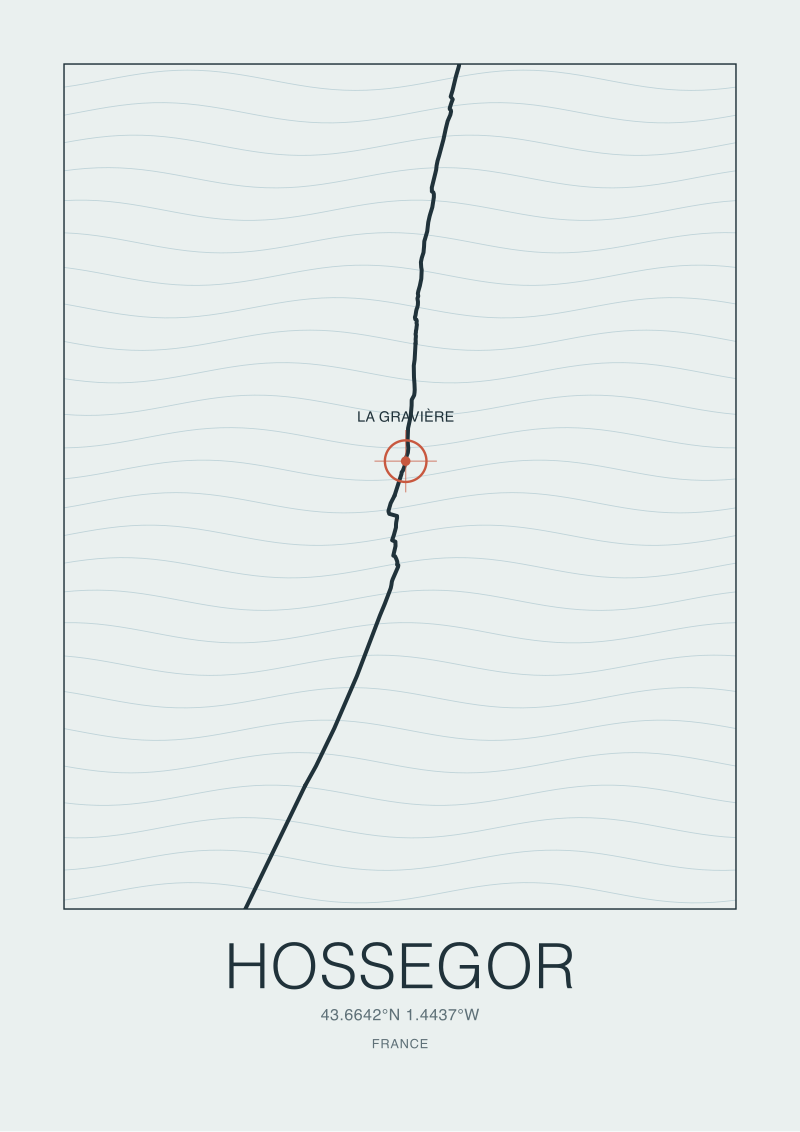
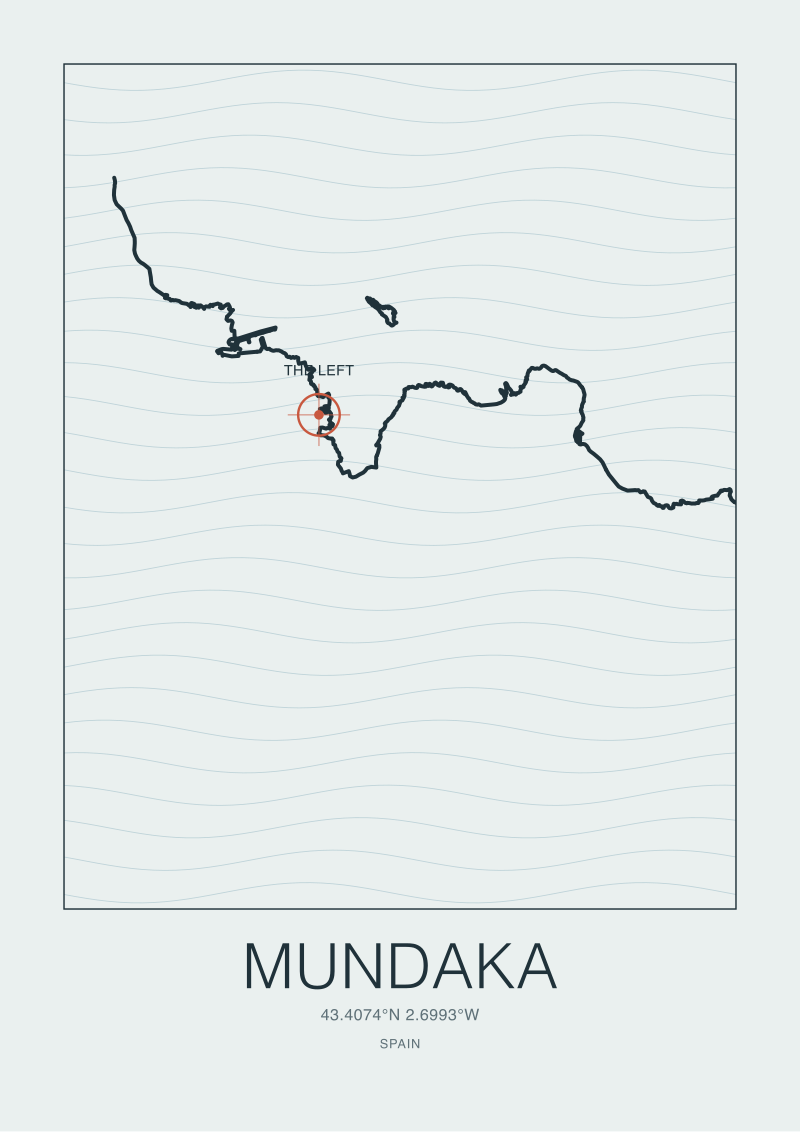
The Grande Plage is a beach break. So is most of the coast running north from Biarritz through Anglet, Capbreton and Hossegor. This is why French Atlantic surf is famously inconsistent in a way that a place like Mundaka is not: the map underneath the water is redrawn constantly. A studio drawing a beach break honestly should draw the beach and note that the wave-carrying feature — the sandbar — is unmapped by design. It exists, but not on any coastline plate. The reader has to accept that some layers of a surf coast are provisional.
Swell Window
A swell window is the arc of ocean, measured in compass bearings, from which useful surf can actually reach a stretch of coast. Anything outside that arc is blocked — by other landmasses, by an island chain, by the shape of the continental shelf. Any coast's honest surf identity is defined less by its beaches than by its swell window.
Biarritz's swell window opens roughly toward the west and northwest, into the deep Atlantic. Storms in the North Atlantic, sometimes thousands of kilometres away, generate the long-period swells that arrive at the Grande Plage days later with their energy still intact. There is no island between Biarritz and Newfoundland to filter that energy. This is why the Basque coast has surf at all — and why coasts sheltered by geography (much of the English Channel, the inner Baltic, most of the Mediterranean) do not, regardless of how attractive their beaches look on the plate.
Bathymetry
Bathymetry is the topography of the seafloor — the underwater equivalent of a landscape of hills, valleys, and canyons. Every surfable wave in Europe is, physically, a swell interacting with bathymetry. When a long-travelling ocean wave meets shallower water, it slows, steepens, and eventually breaks. Where and how it breaks is entirely a function of what the seafloor looks like at that spot.
We flag bathymetry as a term because it is the invisible half of every surf coast. A studio can plot a coastline from OpenStreetMap — sharp, ODbL-licensed, ground-truthed — but the seafloor is a different data layer, sourced from bathymetric surveys, often coarser and more contested. The Grande Plage is a good wave because its offshore bathymetry gently ramps the swell up over sand. Other Basque and Portuguese breaks are famous because of much more dramatic bathymetry: canyons, ledges, deep-water gates that concentrate energy. The map above the waterline is only ever half the story.
Longboard Era
The longboard era refers, in European surf memory, to roughly the late 1950s through the mid-1960s: the years when the boards available and the boards ridden were long, heavy, and single-finned. The style demanded by that equipment — smooth, drawn-out lines, a walk to the nose, patience with the wave — became the visual grammar of early European surfing and, in Biarritz specifically, of the Côte des Basques.
That grammar still shapes how the town is drawn today. Old photographs from Biarritz's first surf decade show longboards, cliffs, and cabines de bain in the same frame — a coastal aesthetic that the town has kept as heritage rather than replaced. When a shop on the Rue Mazagran sells a print of the Côte des Basques, it is often selling this era's silhouette. A studio drawing the coast has to decide whether it is drawing 2026 Biarritz or the longboard era's Biarritz. They are the same coastline, but not the same picture.
Surf Club
A surf club, in European context, is the local social unit through which the sport organised itself before governing federations existed. The Waikiki Surf Club, founded in Biarritz in 1959, is generally cited as the first of its kind on the continent — a small group of Basque and French enthusiasts who put the informal Biarritz scene on institutional footing.
We use the term to mark a specific historical transition: the moment surf in Europe stopped being one man with a board and started being a membership, a clubhouse, a set of rules for how a beach is used. From the surf club came competitions, from competitions came federations, from federations came the modern architecture of European surfing — regional associations, national teams, Olympic pathways. The Waikiki Surf Club is the small hinge on which all of that turns. A studio drawing Biarritz for a print is drawing, whether it knows it or not, the town where that hinge was installed.
Coastal Vernacular
Coastal vernacular is the phrase we use for the layered visual and linguistic language a stretch of shore develops around itself: the architecture of its bathing cabins, the names of its rocks and points, the fonts on its signage, the toponyms that survive from Basque or Breton or Cornish. It is what makes a Biarritz cliff feel like Biarritz and not like Sagres or Bundoran.
For a studio that draws surf coasts, the vernacular is the reason a coastline plate is never enough on its own. Two shores with identical bathymetry, identical swell windows, identical waves will still read as different places because their vernacular differs. Biarritz's vernacular is Basque coastal Belle Époque with a longboard overlay — cliffside villas, a striped-cabin memory, a Basque flag, a 1959 club. That is the layer a print carries when it hangs on a wall. The coastline is the drawing. The vernacular is why the drawing is of somewhere in particular. If you want to hold the Grande Plage as a piece of paper, our shop at see the Biarritz print is where the coast leaves the map.
FAQ
Why is Biarritz considered the starting point of European surf culture and not somewhere else?
The record turns on the arrival, in 1957, of the American screenwriter Peter Viertel with a California surfboard, during production of the Hemingway adaptation "The Sun Also Rises." He rode waves off Biarritz's beaches, the board stayed in town, and a small Basque and French circle formed around it. Earlier incidents of wave-riding on European coasts exist as folklore, but Biarritz is where the continuous, self-aware scene begins as documented history.
Where exactly is Biarritz, geographically?
Biarritz sits at roughly 43.4853°N, -1.5584°E, on France's southwestern Atlantic coast, in the French Basque Country. It faces the Bay of Biscay, with an open swell window into the deep Atlantic and no island between the town and the North American continent. The coordinates place it about 35 kilometres north of the Spanish border and directly across the bay from Cantabria.
What is the difference between the Grande Plage and the Côte des Basques?
The Grande Plage is Biarritz's central, arc-shaped town beach, historically the postcard beach and the first address of the sport in Europe. The Côte des Basques is a longer, cliff-backed beach a short walk south, exposed to similar swell but with a gentler, sandier apron that suited the heavy longboards of the late 1950s. The Côte des Basques became the town's teaching and longboarding beach; the Grande Plage remained its icon.
What is a swell window and why does it define a surf coast?
A swell window is the arc of open ocean, measured in compass bearings, from which useful wave energy can reach a coast without being blocked by other landmasses. Biarritz's window opens west and northwest into the Atlantic, which is why long-period storm swells from thousands of kilometres away arrive intact. Coasts with narrow or fully blocked swell windows — much of the Mediterranean, most of the Baltic — cannot produce comparable surf regardless of local weather.
Was there a first surf club in Europe, and if so, where?
The Waikiki Surf Club in Biarritz, founded in 1959, is generally cited as the first formal surf club on the European continent. Its significance is less about competition and more about institutional footing: it moved Biarritz's small informal scene into a membership structure that later scaled outward into regional and national federations. Almost every organisational lineage in modern European surf can be traced back through that club.
Why is bathymetry mentioned so often in surf writing?
Because bathymetry — the shape of the seafloor — determines how a swell breaks. The same wave arriving at two different coasts becomes two entirely different rides depending on whether it meets a gently rising sandy bottom, a steep reef, or an offshore canyon. A coastline plate drawn from OpenStreetMap shows only the water's edge; the wave-defining geometry lives below the surface and is a separate, coarser data layer that no on-shore map fully captures.
Do I need to surf to appreciate a coast like Biarritz's?
No. The coast reads perfectly well as geography, history, and vernacular even to a reader who never enters the water. The studio's own view is that the coastline itself — its shape, its towns, its Basque and Belle Époque overlays, the specific fact of the year 1957 — is the primary object of interest. Surf is one of the languages that coast happens to speak, not the reason the coast is worth reading.
New breaks and 10% off your first print.
One email now with your code. No noise after.