The people asking us weekly ask a version of the same question: "Is Newquay worth it, or is it a stag-do town with a beach attached?" The answer is that both descriptions are simultaneously true and useless, because Newquay is not one place. Newquay is a headland. Hear us out. The headland does what headlands do — it separates weathers, breaks, and moods on two sides of a rock. So we have written this piece as a flowchart. Three questions. Answer them in order. At the bottom of the page there is a table that maps every combination of answers to one recommendation. Nothing here tells you where to sleep, what to spend, or how to pop up. Everything here tells you which coast to stand on.
Question 1: Are You Routing Your Visit by Fistral, or by the Coastline?
This question matters because it decides whether Newquay is a destination or a station on a longer coastal walk. Fistral sits on the western face of the headland at roughly 50.42° N, 5.10° W. It faces the open Atlantic. It is the reason Newquay's name is in this article's title. But it is one beach on a coast that runs for miles either side of it, and orienting your visit around Fistral alone is like visiting a cathedral city and only seeing the door.
If Yes — You Came for Fistral
Fine. Fistral is a wide, west-facing beach break with a sand bottom, and it does the thing beach breaks do: it reorganises itself with every tide, so the wave you read about in a magazine from 2018 is not the wave you get today. Walk the beach at low tide first. Look at where the sand has piled up — those piles are your sandbars, and they are where the waves will break. That is a fifteen-minute exercise. Do it before you do anything else.
If No — You Came for the Coast
Then Newquay is your basecamp, not your subject. The coast on either side of the headland runs north toward Trevose and south toward Perranporth, and it is some of the most legible coastline in Britain — cliffs that record their own history in stripes, coves that argue with the tide, and a shoreline whose length depends entirely on the ruler you measure it with. Which brings us to the next question.
Question 2: Do You Have Less Than Forty-Eight Hours?
This question matters because Newquay looks small on the map and behaves large in person. The headland itself is walkable in a morning. The coast on either side of it is not. If your visit is short, you are choosing what to skip. If it is longer, you are choosing what order to see things in.
If Yes — You Have Less Than 48 Hours
Pick one side of the headland and stay on it. Attempting to see Fistral, the eastern bay, the harbour, and the beaches four or five miles north and south of town in one weekend is a way to arrive home having seen everything and remembered nothing. The headland itself — the walk that crosses from the eastern side to the western side over Towan Head — is roughly a two-hour circuit that will teach you more about the town than any drive. Do that circuit slowly.
If No — You Have More Time
Then read the coast in sequence rather than in scatter. North of Newquay the character shifts within a few miles — the cliffs step up, the coves get narrower. South of Newquay the coast opens into dune systems and estuary mouths. Give each section its own half-day. Do not try to compress the coast into a single loop; the coastline paradox is not just a mathematical curiosity, it is why every attempt to "do" Cornwall in a day fails.
 Newquay
The print from this article · from €29.95
View the print →
Newquay
The print from this article · from €29.95
View the print →
Question 3: Are You Drawn to the Beach Breaks or to the Cliff Geometry?
This question matters because Cornwall's north coast offers two kinds of coastal experience, and they reward different attention. Beach breaks are horizontal — you read them by walking the low-tide sand and watching where waves reorganise. Cliff geometry is vertical — you read it by walking the coast path and watching how the land ends. Newquay does both. The reader who arrives expecting one and gets the other tends to leave disappointed.
If Yes — You Want the Beach Breaks
Then plan around tide, not around itinerary. Beach breaks are most legible for the two hours either side of low water, when the sandbars are visible and the surface tells you what the bottom is doing. High tide covers the argument. This is true at Fistral. It is true at every beach north and south of it. If your day is scheduled around a lunch reservation, you have not planned around the coast — you have planned around the town.
If No — You Want the Cliff Geometry
Then the headland is the classroom. Stand on Towan Head at low tide and look west toward Fistral. What you are seeing is the same weather system arriving on two beaches, refracted differently by the shape of the shore. That refraction is what makes surf coasts what they are: the ocean does not decide where waves break, the coastline does. Walk the path clockwise from the eastern bay to Fistral and you will read the argument in real time.
If You Answered Everything
Here is the map of answers to recommendations. Read across your row.
| Q1 (Fistral / Coast) | Q2 (<48h?) | Q3 (Breaks / Cliffs) | Recommendation |
|---|---|---|---|
| Fistral | Yes | Breaks | Walk Fistral at low tide, read the middle sandbars, skip everything else. |
| Fistral | Yes | Cliffs | Cross Towan Head first, then treat Fistral as the second half of the same walk. |
| Fistral | No | Breaks | Base at Fistral, day-trip to one beach north and one south for contrast. |
| Fistral | No | Cliffs | Fistral is basecamp; the coast path north to Trevose is the actual point. |
| Coast | Yes | Breaks | Skip Fistral, drive south to Perranporth, read a wider beach at low tide. |
| Coast | Yes | Cliffs | Do the headland walk twice — once at low tide, once at high — and stop there. |
| Coast | No | Breaks | Book five nights and work north to south, one beach a day, tide-first. |
| Coast | No | Cliffs | Base in Newquay, walk the coast path in both directions on alternate days. |
Two rows deserve a footnote. If you answered Coast / Yes / Breaks, the reason we send you south of town is that a longer beach lets you read a beach break's argument at a scale Fistral cannot match — Fistral is wide, other stretches are wider, and the extra room means more sandbar variation to read. If you answered Fistral / No / Cliffs, Fistral stays as basecamp only because it has the parking and the food; the actual point of the trip is the path.
What This Piece Did Not Cover
This piece does not tell you where to eat, sleep, or drink. Those things change every season and belong to guides written by people who visit Newquay every month, which we do not. It does not tell you when the surf will be good — we are a cartography desk, not a forecast, and no honest piece can tell you what next Saturday's swell will look like. It does not tell you whether to buy a wetsuit or which board to bring; that is a conversation for a surf shop on the ground, and Newquay has several.
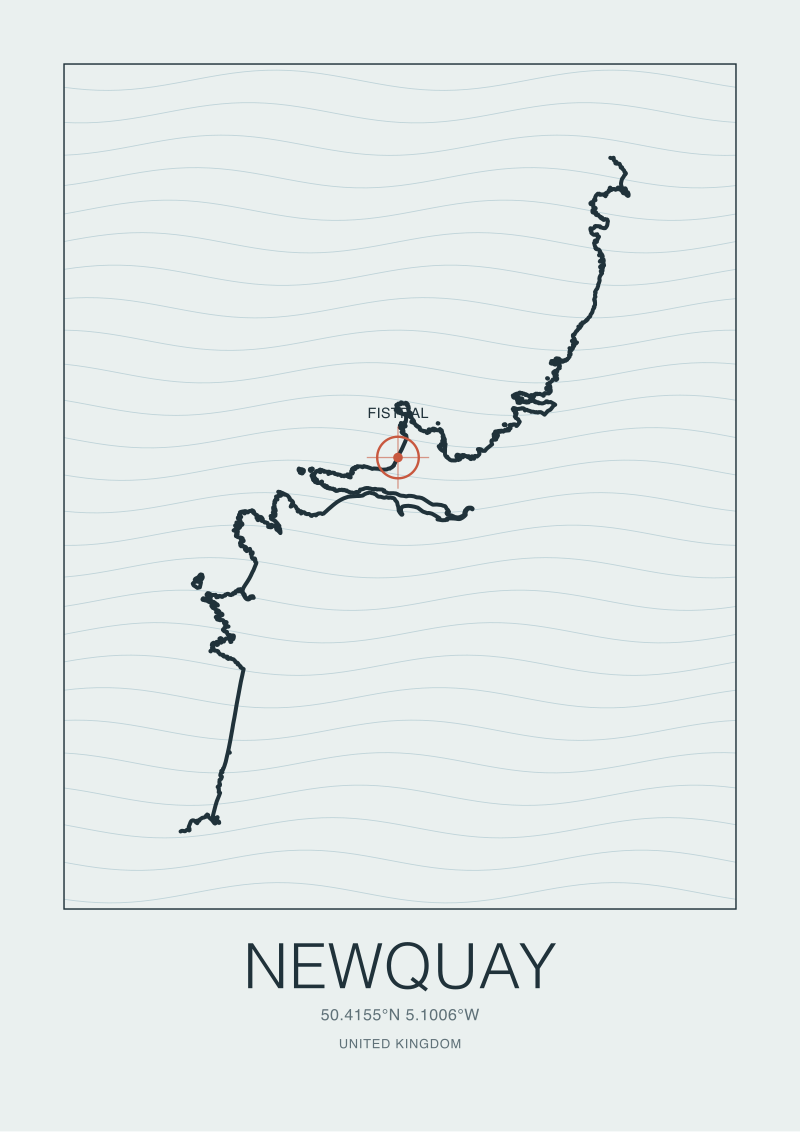
What we did do is give you a map that the town rarely gives itself: Newquay as a headland, with two coasts, read by three questions. If that map is useful, we draw the same headland — coastline traced from OpenStreetMap's ODbL data — as a print for our /shop/. It hangs above a desk better than it hangs above a bed.
FAQ
Is Fistral actually the best beach in Newquay?
Fistral is the most exposed and the most famous, which are not the same as best. If you want a west-facing beach break with room to spread out at low tide, yes. If you want shelter from a north-westerly wind, no — the eastern side of the headland will read better. "Best" is a function of what the weather is doing and which side of the rock you happen to be standing on that morning.
What time of year should I visit Newquay for surf?
This is genuinely outside our remit. We map coasts; we do not forecast swells. The general observation is that Atlantic swell tends to arrive more reliably in autumn and winter, and Cornwall gets some of that — but any specific week is a coin flip. Ask a local surf shop the week you arrive, not a cartography desk six months in advance. Anyone promising a "good week" this far out is guessing.
Can I walk between the two sides of the headland easily?
Yes, and this is the single most useful thing to do on arrival. The route crosses Towan Head and takes roughly twenty-five minutes at a walking pace. Doing this walk first orients everything else. You see both coasts, you see how the same weather arrives at them differently, and you stop treating Newquay as one beach with a town attached. It is the closest thing to a free lesson in coastal geometry the town offers.
Is Newquay a good base for exploring the rest of Cornwall's coast?
Yes, with a caveat. It sits roughly halfway along the north coast, which makes day-trips north or south manageable. It does not put you close to the south coast — Falmouth, the Lizard, and the far west require a proper drive. If your interest is the whole of Cornwall, Newquay is a north-coast basecamp, not a Cornwall basecamp. Choose accordingly, and do not expect the drive times a straight-line map suggests.
Why do published figures for Cornwall's coastline length disagree?
Because coastline length depends on the ruler. This is the coastline paradox: measure Cornwall with a hundred-mile ruler and you get one number; measure it with a hundred-metre ruler and you get a larger one. The OpenStreetMap coastline data we use has a specific resolution, and every published figure — three hundred miles, four hundred miles, more — is a statement about the ruler as much as about the coast.
Do I need a car to visit Newquay?
The headland itself is walkable without one. The beaches on either side of town are reachable by bus with patience, or by car in fifteen minutes. For a Fistral-only visit, no car. For a coast-reading visit — where the point is to compare beaches a few miles apart on the same tide — a car makes the sequence tractable in a way public transport does not. Rent one for the second half of a longer trip.
Are the coast path sections north and south of Newquay equally interesting?
They are different, not equal. North of Newquay the cliffs step taller and the geology gets more dramatic — this is the section most photographs come from. South of Newquay the coast opens into dune systems and estuary mouths, quieter but no less legible if you slow down. Which you prefer is a question about your reading style: vertical drama or horizontal expanse. Neither answer is wrong; they simply reward different attention.
New breaks and 10% off your first print.
One email now with your code. No noise after.