A surfer who has everything already owns the ocean. Hear me out.
They own the winter wetsuit and the summer wetsuit. They own the shortboard, the fish, the mid-length, and a gun that has ridden a plane exactly twice. They own three of the same fin because they lost one and then found it. They own a wax comb they will never use because a friend gave it to them and they will never throw it out. What they do not own — what almost no one has ever thought to give them — is the shape of the coast where all of that gear ends up in the water. That is not a hole in the gear cupboard. It is a hole in the wall.
This piece is not a list of surf-adjacent objects to add to a cart. We are a coastal cartography studio; we draw European surf coasts from real coastline data and print them on paper. So the question we are trying to answer is narrower than "what to buy". It is: which coast, for which surfer. That does not have a single answer. It depends on who they are when they are not surfing. So we will walk through three of them. Not people we have interviewed. Not clients we have profiled. Composites — archetypes we have watched arrive at the studio over enough seasons that the pattern is now legible. Each one wants a different document on the wall. Each one, if you have been listening, has already told you what it is.
Scenario 1: The Biarritz Loyalist
Picture a surfer whose first wave was at Grande Plage sometime in the late 1990s, and who has arranged the rest of their adult life around going back every August. They have the villa or the friend with the villa. They have the annual reservation at the same restaurant. They have a specific bench on the promenade where they sit before the first paddle of the trip. They do not surf year-round. They surf here.
The gift is a print of the Biarritz coastline centred on Grande Plage. Sea in one tone, land in another, no logo, no beach-club watermark, no "greetings from Biarritz" typography stuck over the point at Anglet. Just the coast: the Grande Plage arc, the headland dropping south toward Guéthary, the estuary line to the north. This is the founding coast of European surf as a cultural fact — 1957 is the reference year, when Peter Viertel arrived to shoot *The Sun Also Rises* and left a board behind, and the story compresses from there into every French surf club, every Basque wetsuit brand, every Grande Plage summer since. The Loyalist knows all of this. What they do not have is the coastline itself, rendered as a document rather than a postcard.
The tell that this is your surfer: they send you photos from Biarritz every August, and none of the photos have waves in them. They have sent you the lighthouse. They have sent you the pines behind the plage. They have sent you the promenade at dusk with no one on it. They have never once sent you a photo of themselves on a board, because the trip is not about the ride. It is about being back at a specific coast. A print of that coast, drawn to scale, is a gift that says you understood which part of the trip they were describing.
One caveat worth naming. The Loyalist does not want their surf history flattered. They know Grande Plage is a summer beach break that mostly closes out; the Basque coast has heavier and more serious waves five kilometres in either direction. A print that pretends Biarritz is a world-class break will read as flattery. A print that renders it as what it is — a specific, historically loaded coastline where surf culture arrived and stayed — will read as respect.
Scenario 2: The Hossegor Trench Hunter
Different profile. Same-ish age, maybe younger. This surfer does not go to France in August. They go in late September, and they book the flights in April. They own a step-up shaped specifically for La Gravière. They have stood in the Landes pine forest before first light, hearing waves they could not yet see. They keep a running ten-year mental record of how many days each September has produced something worth flying for, and they will tell you that record unprompted, correctly, from memory.
The gift is a print of the Hossegor coast that renders the underwater canyon — the Gouf de Capbreton, the deep-water trench that runs almost onshore at La Gravière and focuses open-ocean swell into a specific stretch of French beach two metres bigger than what arrives fifteen kilometres north or south. The bathymetry is not decoration. It is the reason Hossegor is Hossegor. Without the trench, this is a pleasant Landes beach with a pine forest behind it. With the trench, it is one of the most concentrated wave-focusing systems in Europe. A studio print that draws the trench — no towns, no campground boundaries, no WSL tour scaffolding — gives the Trench Hunter the thing they have never been able to explain at a dinner party in one image.
The tell that this is your surfer: when they describe a session, they describe the bank. Not the size. Not the crowd. Not the after. The bank. Where the water was going. Which sandbar had shifted since last September. Which side of the trench was firing. They are structural people. They read the coast as a mechanism. A print that renders the mechanism, not the vibe, will be the first coast document they hang in a house they have owned for eight years. Everything else on the wall until now was placeholder.
One caveat. The Hossegor print is not a "cool wave illustration". It is closer to a hydrographic chart with editorial restraint. If the recipient wants a wave on the wall, you have picked the wrong scenario for them. If they want the reason for the wave on the wall, this is the object.
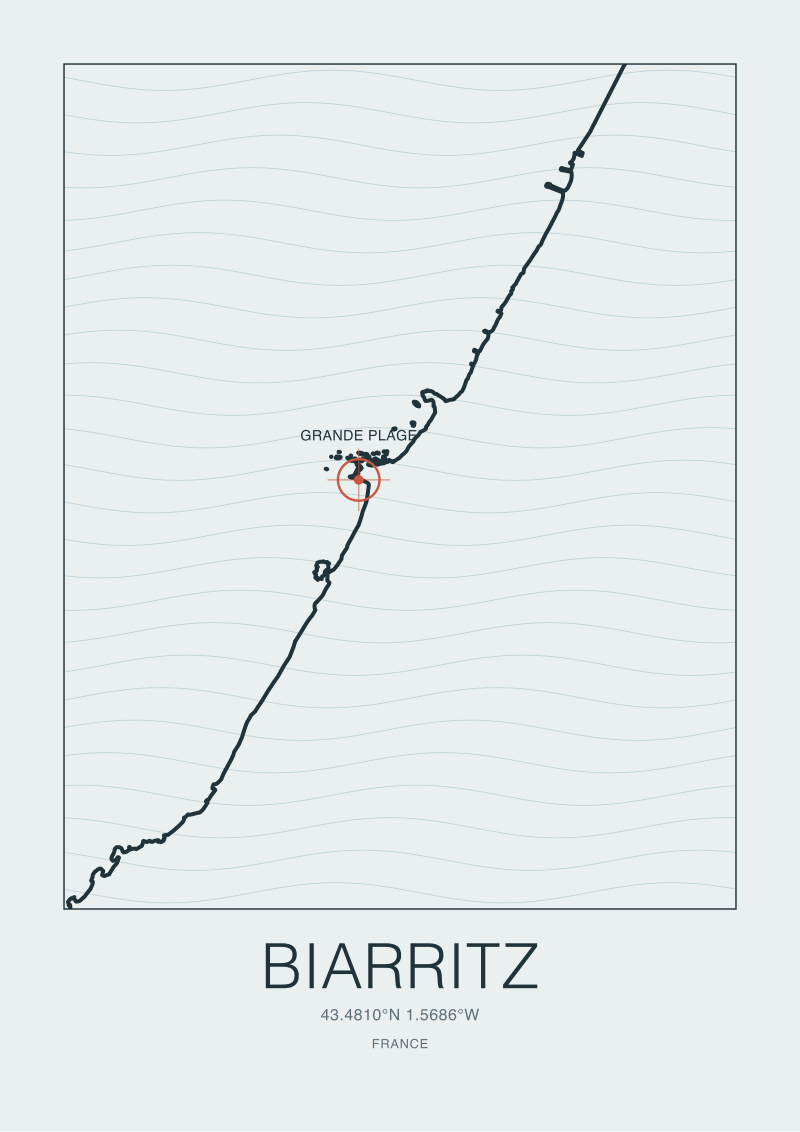 Biarritz
The print from this article · from €29.95
View the print →
Biarritz
The print from this article · from €29.95
View the print →
Scenario 3: The Ericeira Convert
Middle profile. Started in Cornwall, or Newquay, or the cold-water North Sea, and had their head turned by a first trip to Ericeira around 2018 or 2019. Now goes three times a year, always for the shoulder seasons. Their contact card lists a Portugal number. They know what World Surfing Reserve designation means and can explain it at a dinner party in one sentence without becoming tedious. They do not describe Ericeira as "the wave" — they will correct you, gently, if you do.
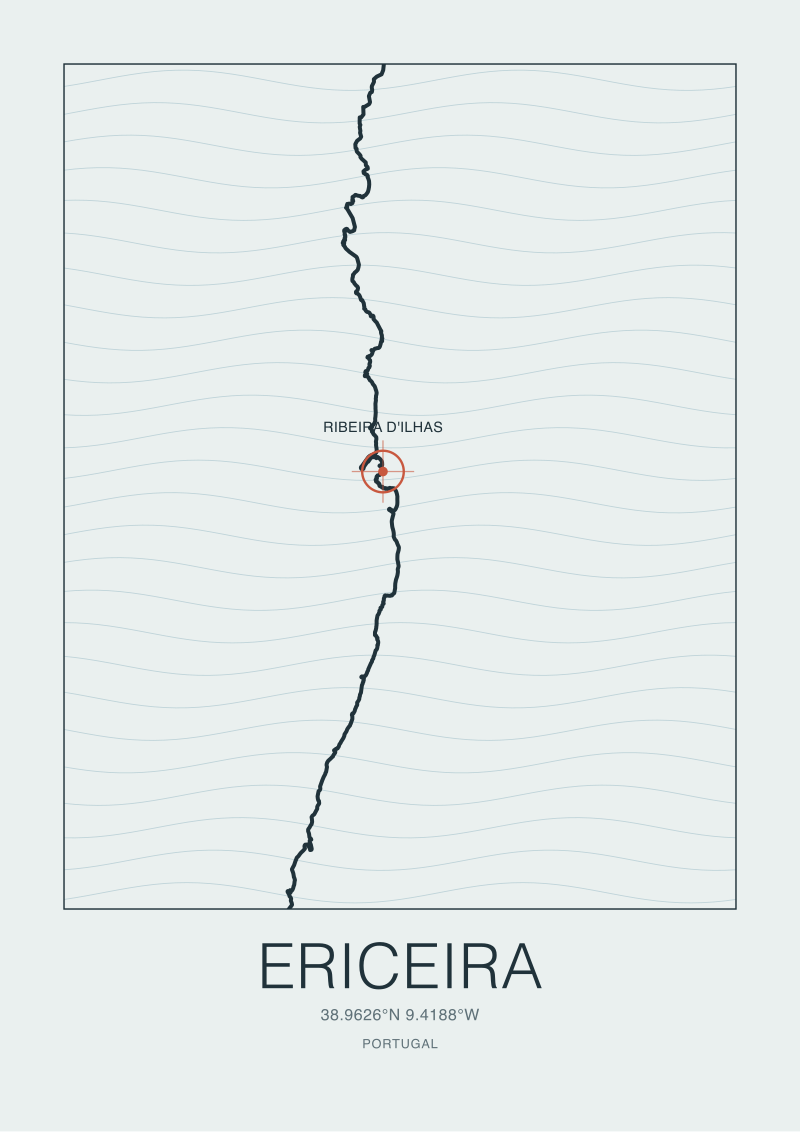
The gift is a print of the entire Ericeira coastline rendered as the reserve: Ribeira d'Ilhas, Coxos, Pedra Branca, Reef, Cave, Crazy Left, São Lourenço — the roughly four-kilometre continuous coast that carries the 2011 reserve designation, drawn as one document rather than seven bullet points. Ribeira d'Ilhas is where the tour goes, and where a non-Convert thinks Ericeira is. The Convert knows the reserve is a system: different swells favour different spots, the designation protects the coastal geography that produces all of them, and losing one to development would degrade the others. A print that shows the reserve as continuous geography — not as a list of surf spots — is a gift that recognises the recipient understands the coast is a system.
The tell that this is your surfer: they talk about reserve designation the way other people talk about a favourite bookshop. They are protective without being sentimental. They notice when a new build appears on a headline they know. They will hang this print at eye level, next to something else they think of as evidence rather than decoration.
What All Three Share
Look at what these three composites have in common, because the pattern is the actual answer to your question.
They love the place before they love the ride. This is why the gear-based gift fails at their level: the gear has been solved. The place has not. The place cannot be solved by acquisition, only recognised — and recognition is what a coast print, drawn from real coordinate data, actually is.
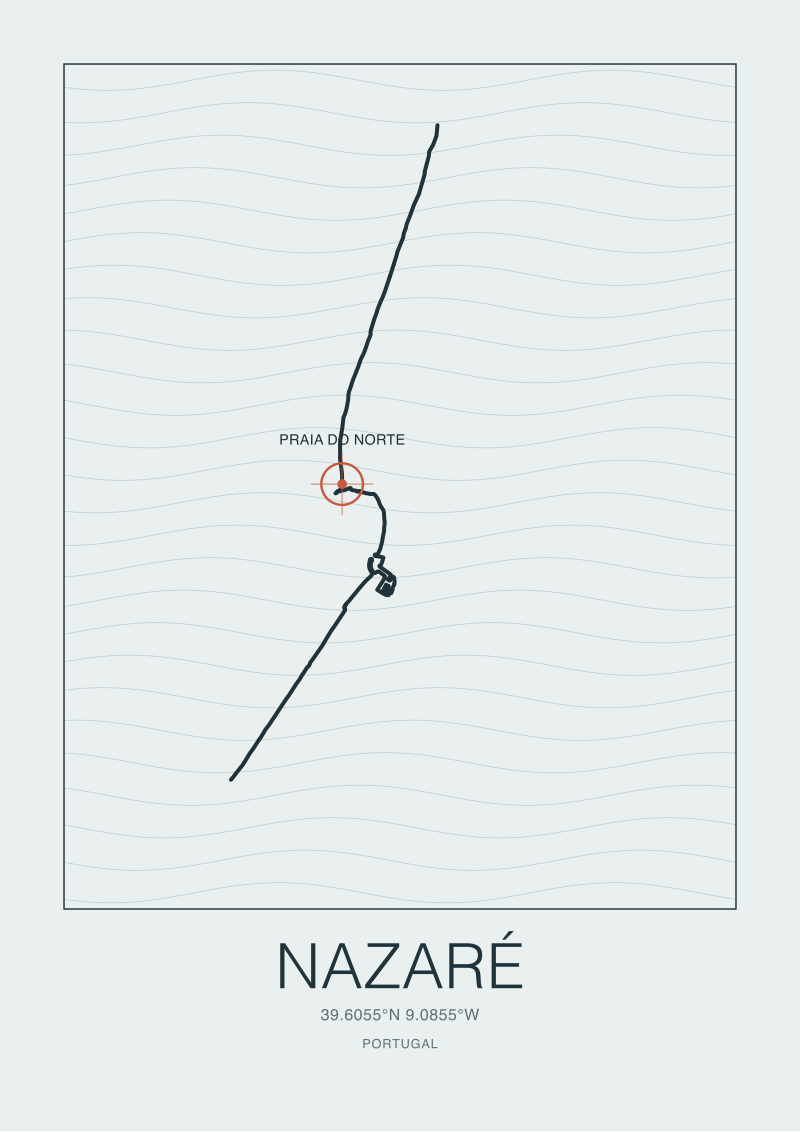
They own the invariant. Boards get retired. Wetsuits perish. Fins are lost in shore-break. The coast stays. Nazaré's canyon existed before the first surfer arrived and will exist long after the last one leaves. Hossegor's trench, Biarritz's arc, Ericeira's reserve boundary — these are the things that outlast the gear cupboard. Handing someone a document of the invariant is a different category of gift from handing them another consumable.
They will hang it where they see it every morning. Not in the garage next to the boards. Above the desk, or in the kitchen, or in the hallway they walk through with coffee before anyone else is up. Surfers-who-have-everything already have the surf identity on display in the garage. What they do not have is the coast on display in the room where they think.
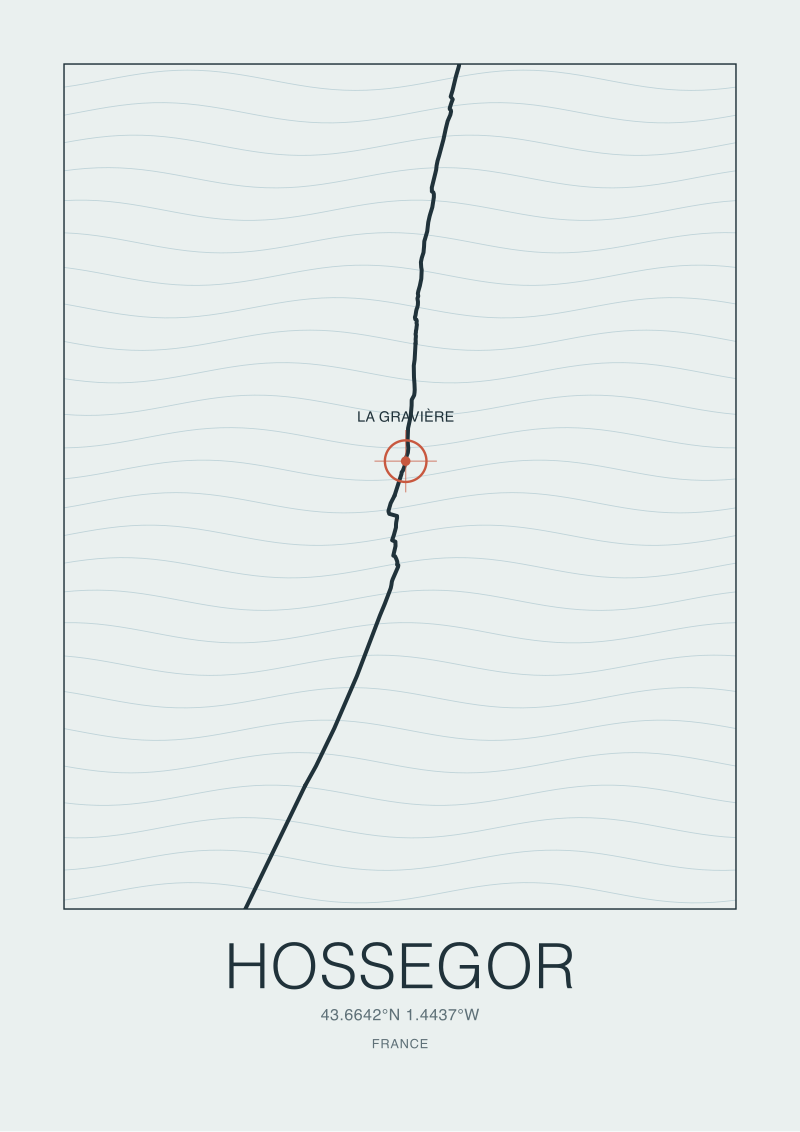 Hossegor
The print from this article · from €29.95
View the print →
Hossegor
The print from this article · from €29.95
View the print →
Which Scenario Is You
If you have read the three composites and one of them made you laugh with recognition, you already know. Buy the print of that coast. Do not overthink the frame.
If two of them fit — the Biarritz story and the Hossegor structural obsession, say — pick the one that describes the surfer when they are not surfing. The August ritual, the September planning, the Portugal contact card. The gift lives in the year-round self, not in the two weeks a year the boards leave the rack.
If none of them fit, the recipient may not be a coast romantic at all. They may be a competitor, or a gear technician, or someone who genuinely just likes the ride and does not need the place. In that case, the coast print is the wrong gift and we would rather you not buy it. We keep the catalogue in the shop — coasts we have already drawn, and a short form for coasts we have not. The right gift is the one that matches what the recipient actually loves; if that is not coastline, we would rather you find the thing that is.
FAQ
What if the surfer I am buying for surfs in more than one place?
Pick the coast they talk about when nobody is asking. Every serious surfer has one coast that lives in the background of their sentences — the trip they mention in April even though it is not until October, the place they compare every other place to. That is the coast to draw. A print of a coast they visited twice will read as decoration; a print of the coast that lives in their year-round head will read as recognition. If you genuinely cannot tell, ask a mutual friend which coast comes up most, not which one they liked most recently.
Is a coast print really a gift for someone who already owns everything?
The point is not that a print costs less than a board, though it does. The point is that surf gear is a solved category for this recipient — one more shortboard is not the gift, because the shortboard problem is closed. The coast itself has never been on the wall as a document rather than a postcard. That is an open category, and open categories are where memorable gifts live. This holds even if the recipient owns other art. A drawn coastline of their coast is a different object from a general seascape.
How do you decide which spots or towns to include on a print?
We draw the natural coastline from OpenStreetMap coastline data and let the geography lead. Towns and labels are used sparingly, only where they help the eye locate the coast — a lighthouse, a headland name, a river mouth. We do not stack spot names across a print like a surf atlas; that turns the coast into a list. The document should read as a coast first and a surf reference second. If the recipient wants a specific spot marked, we can, but the default is restraint.
Does this work for surfers whose coast is not in Europe?
Our current studio focus is European coasts — the four we referenced in this piece, plus the extended catalogue we have been building around the Atlantic seaboard. If the recipient's coast is elsewhere, tell us. We take commissions for coasts we have not yet drawn when the source coastline data supports the same standard of accuracy. What we will not do is fake a coast we have not properly researched. A print of the wrong coast is worse than no print at all.
Is this a last-minute gift?
Prints from the existing catalogue ship on our published schedule; a commissioned coast takes longer because the drawing is the work. If the occasion is inside two weeks, choose from what we already have on the site. If you have a month or more, and the recipient's coast is not yet in the catalogue, that lead time is genuinely worth taking. A commissioned coast is a slower gift by design, and that is part of what makes it read as considered.
What if the recipient prefers a specific spot rather than a whole coast?
A single-spot print is a legitimate object, but it is a different one. It reads as commemorative — a specific bank, a specific reef, a specific memory. A whole-coast print reads as recognition of a place as a system. Pick the shape of gift that matches the surfer. Loyalists usually want the whole coast because the whole coast is what they return to. Trench Hunters sometimes prefer a single-spot bathymetric print because the mechanism is the point. Both are honest gifts; they answer different questions.
Do the prints include wave forecasts or surf information?
No. We are a cartography studio, not a forecast page. Our prints show coastal geography — coastline shape, bathymetry where relevant, spot locations where they help the reader — because that is what stays true across decades. Forecasts are yesterday's paper the day after tomorrow. A coast document is meant to hang for as long as the coast does, and that means keeping predictive information out of it.
What is the one coast you would not recommend as a gift?
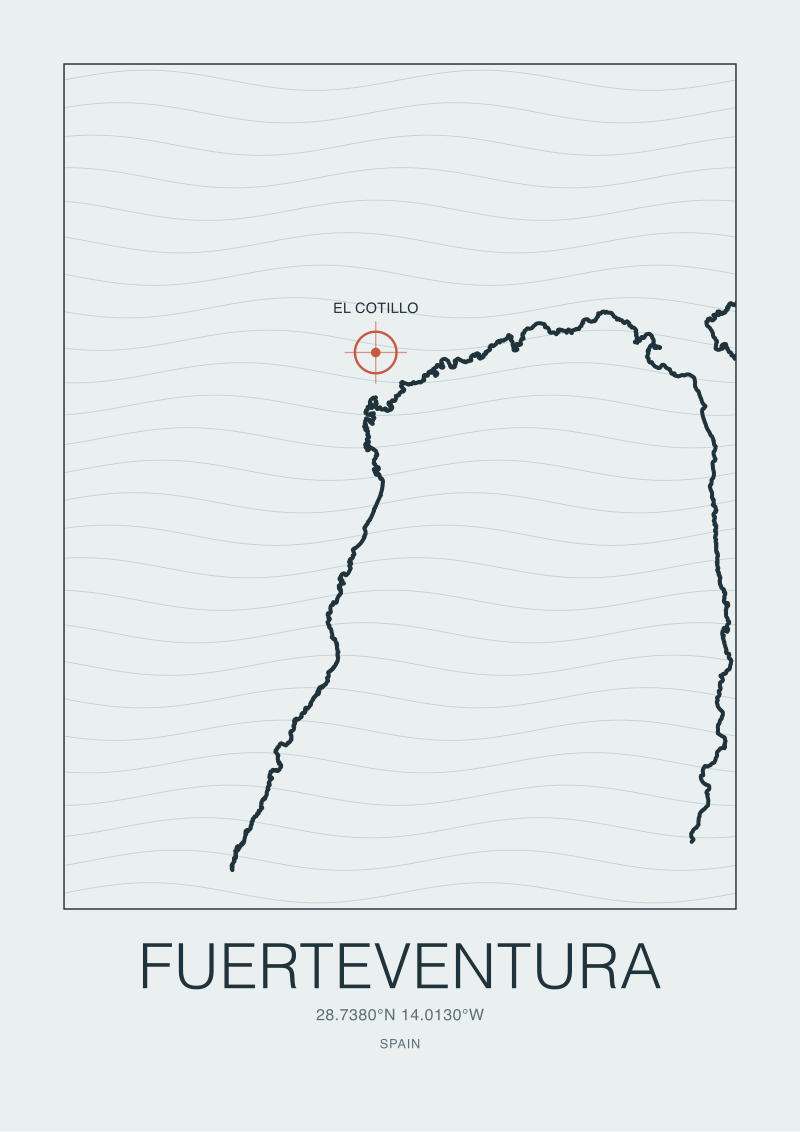
The coast the recipient has never been to and has only heard about. A print of a famous coast that lives in someone else's story is a projection, not a gift. If the recipient has surfed Fuerteventura once on a package trip and mostly remembers the rental car, do not buy them the Fuerteventura coast. The gift only lands when the coast is already part of the recipient's own year. Buy the coast they have earned by returning to, not the one the algorithm has decided is impressive.
Which brings the question forward, past this piece. The next question is not what to give. It is which coast the recipient would draw themselves if they had our coordinate data and a quiet afternoon. That is the coast we would print. That is where the real work of choosing this gift begins, and it is not where this article ends.
New breaks and 10% off your first print.
One email now with your code. No noise after.