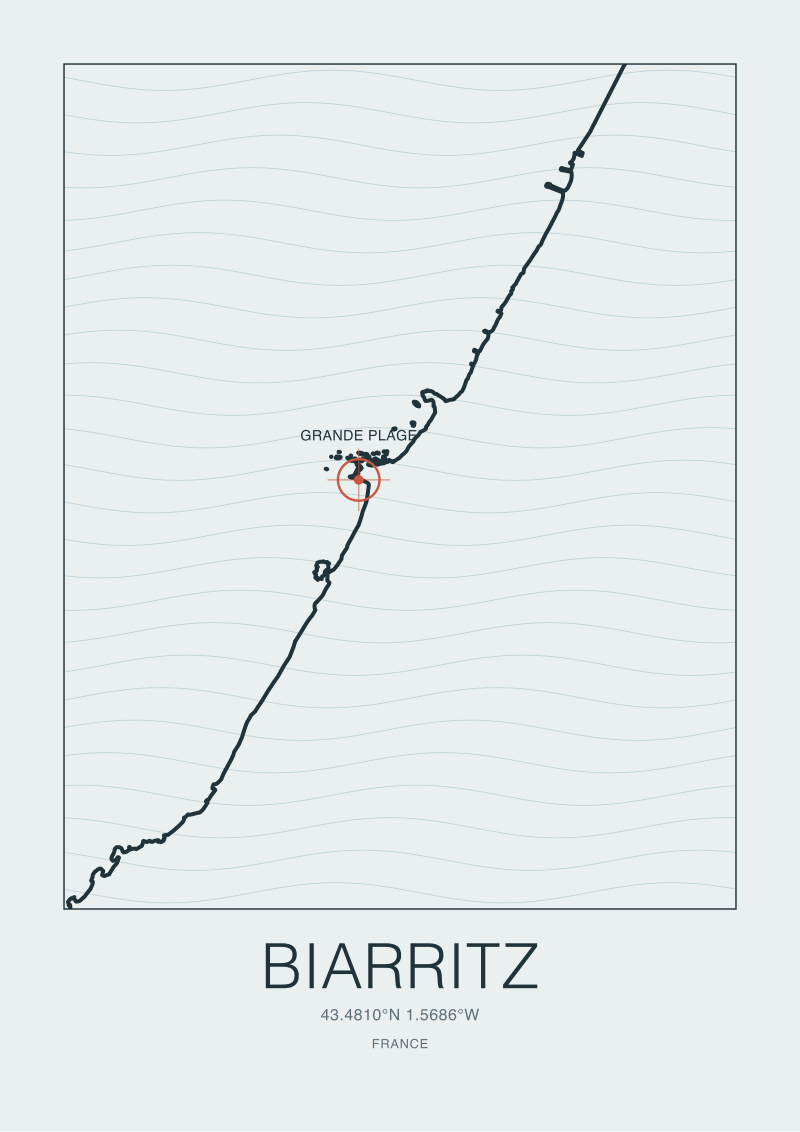
There is a pattern we keep noticing when readers ask us to draw the surf history of Europe: they expect the map to start at the wave, and it never does. It starts at a room. Biarritz gets the credit — 1957, Grande Plage, the point on our charts sitting at 43.4853° N, -1.5584° E — and the credit is deserved, but not for the reason most retellings offer. Europe had swell before it had surfing. What Biarritz had, that the rest of the continent's coasts did not yet have, was a small group of people willing to treat the wave as culture rather than curiosity. That distinction is the whole essay.
The Origin-Point Fallacy: Waves Predate the People Who Get Credited for Them
There is a pattern we keep seeing in origin stories, and it collapses geography into a date. A town gets a year, the year gets a plaque, and the plaque gets copied into every guidebook until the older, longer, less tidy history disappears underneath it. Biarritz is not immune. Ask most retellings when European surfing started, and you will be handed 1957 like a receipt. The receipt is not wrong. It is simply thinner than the transaction it records.
Waves have been arriving at the western edge of France for as long as there has been a Bay of Biscay to funnel them. The Atlantic delivers groundswell to this stretch of coast on a rhythm older than any human record — long-period energy generated by storms hundreds of nautical miles offshore, curving through the abyssal geometry of the Bay, arriving at Grande Plage with a shape shaped entirely by the seafloor between here and there. The wave in front of the Casino Municipal in the summer of 1957 was not new. It had broken there, on some version of the same sandbars, every summer of every year of every century preceding it. Basque fishermen worked these waters for a thousand years and knew, in the wordless way coastal people always know, which afternoons the swell would push the sea sideways.
What was new in 1957 was not the wave. It was the readiness of a small group of people to see the wave as something you could belong to. The Californian screenwriter Peter Viertel, in town with his wife Deborah Kerr for the film adaptation of Hemingway's *The Sun Also Rises*, brought a board. He brought a habit. Local witnesses — Georges Hennebutte, Michel Barland, Joël de Rosnay in the years just after — brought the harder thing: the decision to organise around it. Every origin story we have ever chased on a coast has this shape. The natural feature was already there. The culture arrived on someone's back.
The Grande Plage Effect: Why a Hosting Coast Beats a Better Coast
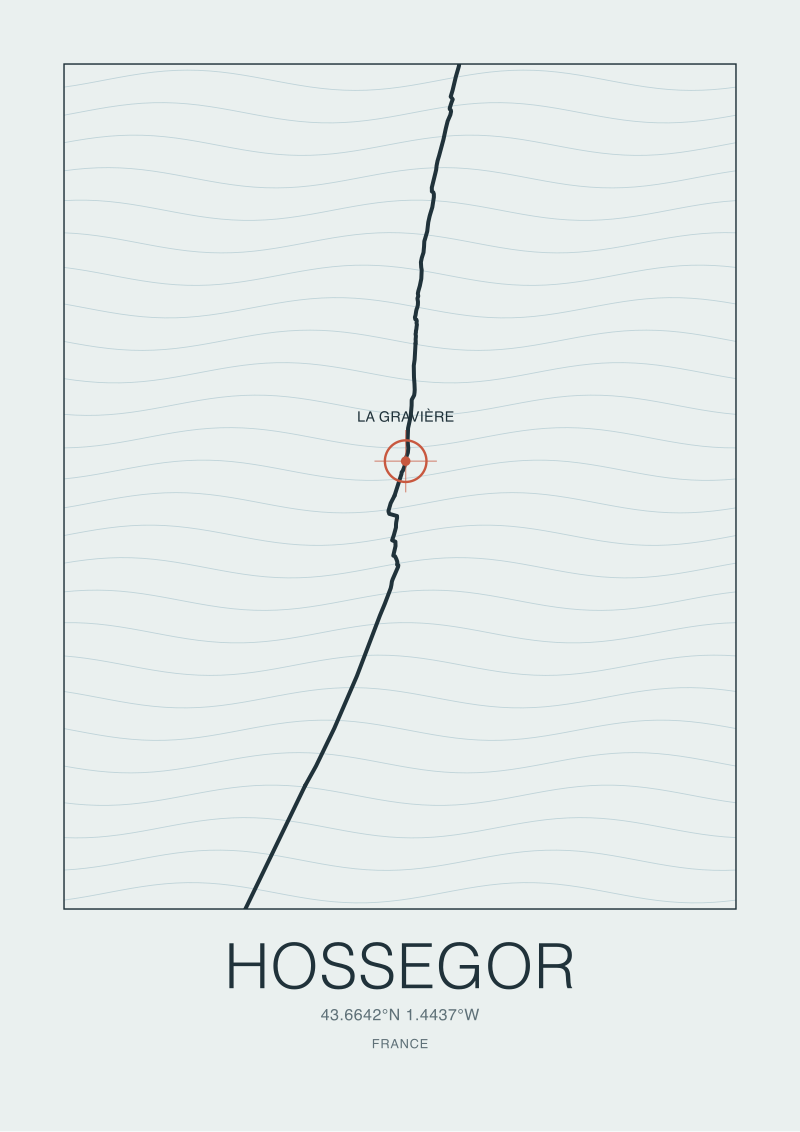
The second pattern, and the one that trips up most histories of European surf, is the assumption that surf culture takes root at the best wave. It does not. It takes root at the most hostable wave. Grande Plage in Biarritz is not, and has never been, the finest wave on this coast. Twenty kilometres north, Hossegor's sandbars — sitting above the Gouf de Capbreton canyon we've written about elsewhere — produce breaking waves of a scale and geometry that make Grande Plage look conversational. To the south, the reefs of Guéthary produce a longer, more mechanical peel. Purely as a wave, Biarritz is honest work. It is not the best line on the chart.
But it was the wave nearest to a resort that already knew how to receive strangers. Biarritz had been a spa town under Empress Eugénie a century before anyone paddled out. It had grand hotels, a casino, a promenade, a rail connection, an economy of hospitality, a pattern of foreign arrivals treated as ordinary rather than exotic. The Grande Plage is not merely a beach break — it is a beach break wedged between two esplanades, watched over by a Belle Époque skyline, walkable from a hotel room where a screenwriter and his actress wife could conceivably spend the summer. This is not incidental. This is causal.
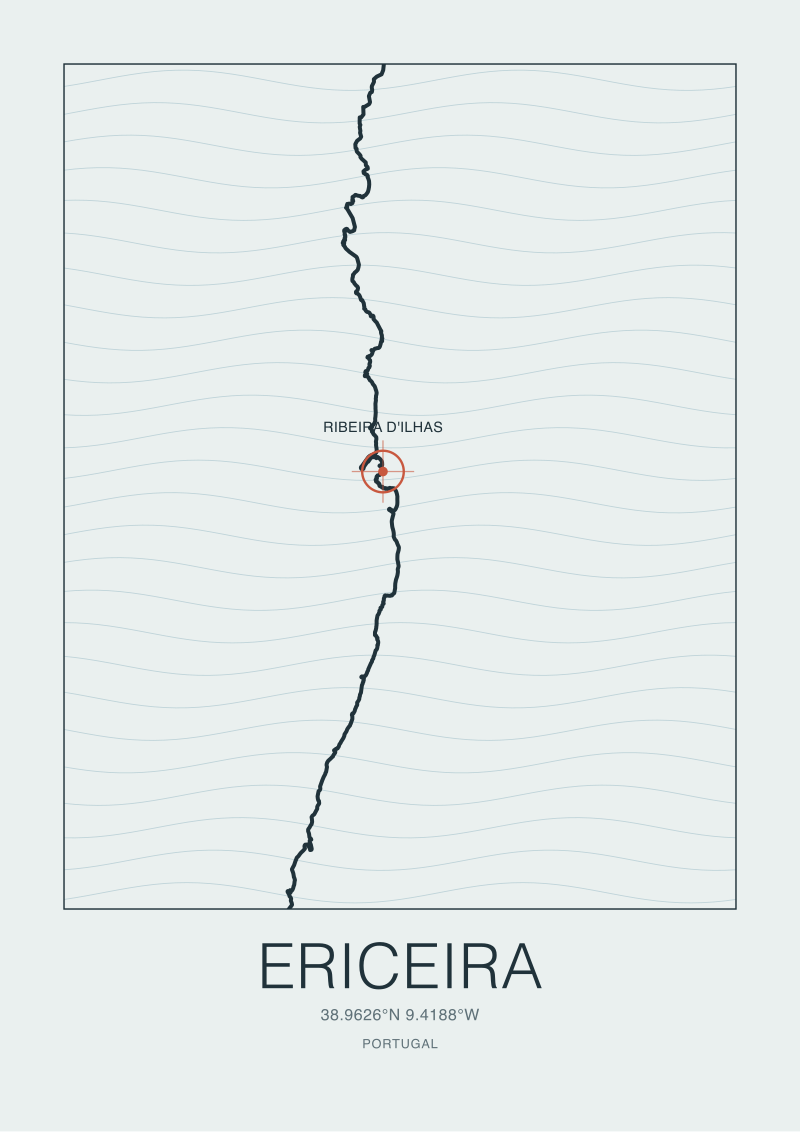
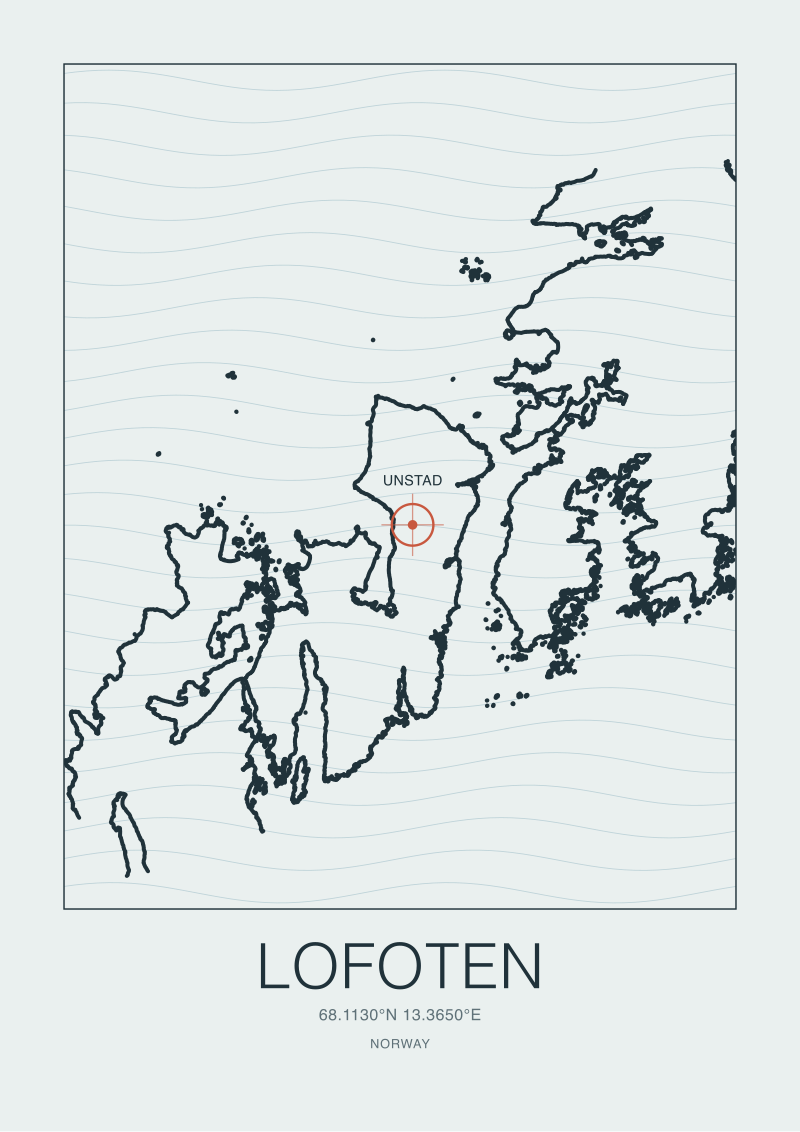
Every map of coastal culture we have ever drawn has this same overlay. Where infrastructure of hospitality already exists, the surrounding coast becomes visible to outsiders. Where it does not, even better waves stay local for another generation. Ericeira had waves in 1957 and did not become European surfing's second city until the eighties. Mundaka was breaking. Lofoten was breaking. Cornwall had the odd bellyboarder. What none of them had, in that specific summer, was the exact overlap of a Californian visitor, a hospitable town, a receptive local, and a wave that broke close enough to a hotel that the culture could survive the winter.
A coastline does not become historic by having the best wave. It becomes historic by being the place a stranger can afford to stay long enough to teach someone.
 Biarritz
The print from this article · from €29.95
View the print →
Biarritz
The print from this article · from €29.95
View the print →
The Diffusion Pattern: How One French Beach Seeded a Continent's Line-Ups
The third pattern — and this is where the story of European surf earns its geometry — is that culture does not spread from wave to wave. It spreads from person to person, and the map lags. In the decade after 1957, the practice moved outward from Biarritz along lines that had almost nothing to do with which coast held the better swell and almost everything to do with which coast held someone who had been to Biarritz.
Barland began shaping boards, and the boards moved. Hennebutte designed the leash. The Waikiki Surf Club of Biarritz — the first surf club on the European continent, formed in 1959 — did what clubs do: it produced a shared vocabulary, a shared calendar, a shared route back to a specific beach. A visitor who came for a summer went home carrying instructions. The instructions travelled up the French coast to Hossegor and Lacanau. They travelled south, across the Bidasoa, into the Spanish Basque country, where they met a different Atlantic and stayed. They travelled to Portugal, where a version of the same story would eventually seed Ericeira. And they travelled, slowly, north into Britain, where the water was colder and the wetsuits worse and the diffusion consequently slower.
Look at the European line-ups of 1975 on a map and you can trace the vector. The dense pockets sit where a Biarritz-shaped person landed with a Biarritz-shaped set of habits. Places with objectively excellent waves and no such carrier — remote stretches of Asturias, entire archipelagos in Norway — waited another twenty years. What Biarritz gave the continent was not a coast. Every European coast had coast. What Biarritz gave the continent was the habit of turning to the sea with a specific expectation. That expectation, and not any wave, is what we mean when we say surfing came to Europe here.
The Founder-Myth Trap: Every Surf Town Claims 1957, and Only One Can Be Right
The fourth pattern is the one that produces most of the arguments in the comment sections of coastal history: every surf town on the Atlantic wants a founder's myth, and the coastline can only support a few. Cornwall's story includes bellyboarders and prone riders decades before 1957 — genuinely, this is not folklore, they existed. Jersey has claims. Portugal has claims. Certain Portuguese-Hawaiian sailors passed through the mid-Atlantic islands in the nineteenth century in ways that produced anecdotes, some of them true. If the question is *when did someone first ride a wave standing up in European waters*, the answer is honestly uncertain and probably older than any of us realises.
But this is exactly the trap. "First to do the thing" and "start of the culture" are not the same event. History has a shape, and the shape is not a race to the earliest date. It is a diffusion field, and diffusion fields have a centre — a point from which practice spreads through networks of people who can be tracked, named, and mapped. On that measure, Biarritz has no serious rival. The 1959 club is documented. The board-shaping shifts to Barland are documented. The line from Biarritz outward is documented in the surname genealogies of European surf boards for the following decade. The other candidate towns produced individual acts. Biarritz produced a network.
We say this cartographically, not chauvinistically. When we draw a diffusion map of any coastal practice — fishing gear, hull shapes, port language — we look for the same signature: a centre where the practice becomes a system, and a set of vectors along which the system travels. The signature at Biarritz is unusually clean. Cornwall's pre-1957 bellyboarders are real. They are also, on the diffusion map, not a centre. They are a scatter. A scatter of individual acts, however earlier in the calendar, is not a founder. The founder is the node that other nodes reach back toward. That node is Grande Plage.
 Ericeira
The print from this article · from €29.95
View the print →
Ericeira
The print from this article · from €29.95
View the print →
So What Do You Actually Do With Biarritz's History
If you are reading this because you plan to be in Biarritz, do this: stop looking for the wave. Look for the shape of the town's relationship to the water. Walk the Grande Plage at low tide and read the sandbars — the way the sea drags out grey-brown bars parallel to the beach, then breaks them into sections where rips have carved through. This is a hosting coast. Its wave does not have to be spectacular; the town around it did the work.
If you are reading this because you write about surf, or make surf films, or teach surf history in a school somewhere, the practical instruction is different. Stop treating founder years as the story. The interesting question is never *when did the wave first break*. The wave first broke before there were humans on the continent. The interesting question is which coast had, at a given moment, the specific combination of habit, hospitality and network that let a practice take root and spread. That question changes what you photograph and what you cite. It moves the camera off the water and onto the promenade behind it.
And if you are reading this because you love coasts the way we love coasts — as places whose geography and human history are the same document read from different sides — the last piece of advice is the simplest. Buy the map before the myth. We draw Biarritz at studio scale, from the real coastline data of Grande Plage and the bays either side of it, at see the Biarritz print, and the map does not tell you Peter Viertel was here in 1957. It tells you why he could be. The founder-myth reduces to a date. The coastline itself keeps the longer story.
Which brings us to the handoff. None of what we've written here tells you what the *next* generation of European surf culture will centre on — whether the diffusion pattern that ran outward from Biarritz for seventy years continues to hold, or whether a different hosting coast, with a different infrastructure of receiving strangers, is quietly becoming the new node. That question is where the real cartography starts, and it is not where this piece ends.
New breaks and 10% off your first print.
One email now with your code. No noise after.